
A world without cash: utopia or dystopia?
Can you imagine a world without banknotes and coins? While such a future is not inconceivable, it is by no means imminent. Yet some believe cash has its days numbered. But could it really be nearing an end? And if so, would it necessarily be a good thing, or could it prove a misstep? The coexistence of physical and digital forms of money allows people to choose what best suits each situation.
Science fiction authors such as Jules Verne and Isaac Asimov envisioned – sometimes with optimism, sometimes with trepidation – technologies that have since become commonplace, including space travel, artificial intelligence and robotics. The idea of a cashless society emerged in the 1950s, as credit cards began gaining widespread adoption, conjuring up a futuristic vision in which electronic payments would replace banknotes and coins altogether.
Seventy years on, that scenario has yet to materialise, although digital payments continue to gain ground. Could we one day become a cashless society? And if so, would it be an entirely good thing?
Is cash still being used? Current trends
The data show that euro banknotes and coins remain widely used as a means of payment and a store of value both in Spain and across the euro area. Indeed, the Banco de España processes cash requests from financial institutions every day, distributing or withdrawing from circulation millions of banknotes and coins, ultimately to ensure that the public's cash needs are met.
To anticipate future trends in cash usage, the Banco de España conducts an annual survey of consumers and small traders. According to the latest Study on Cash Use Habits , 57% of consumers still use cash as their primary means of payment at physical points of sale although it is losing ground to mobile payments, and to Bizum in person-to-person payments (Figure 1).
Figure 1
CHANGING TRENDS IN CONSUMER PAYMENT PRACTICES
Percentage of respondents reporting each payment method as their main means of payment –in terms of the number of transactions, not transaction value– in personal or household transactions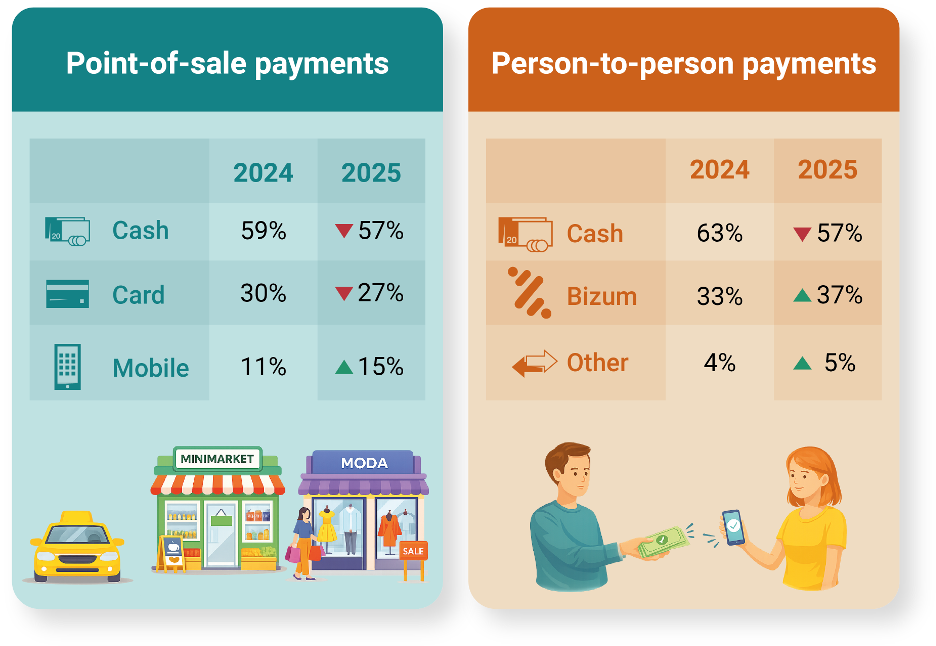
SOURCE: Study on Cash Use Habits 2025
NOTE: In person-to-person payments, “Other” includes bank transfers, other payment methods and respondents who indicated that they do not make such payments.The percentages may not add up to 100% due to rounding.
The study shows that age is currently a key determinant of payment practices: people aged over 54 predominantly use cash, while those between 35 and 54 prefer cards and younger consumers are more likely to use mobile payments. If these trends continue, digital means of payment are expected to become the most commonly used across all age groups by 2046.
All of this points to a gradual and uncertain process. What seems clear, however, is that a cashless society is not imminent – not within the next one or two generations. As for the euro, the European Central Bank (ECB) is supporting the launch of the digital euro as an electronic version of the single currency, but remains committed to physical cash and is currently preparing a new series of euro banknotes.
DID YOU KNOW ...?
The ECB and the national central banks of the euro area –including the Banco de España– are preparing a new series of euro banknotes and want to hear your opinion on their design. You’ll be able to tell us in this online survey which designs you like most from 23 July to 21 September.
What are the benefits of using cash?
According to the Study on Cash Use Habits, the main reasons people give for using cash are habit, convenience and control over spending. The latter, a particularly important factor, stems from the tangible nature of banknotes and coins: the physical feel of cash in our hands makes us more aware of our spending. It also helps to curb impulse buying, since we can only spend the cash we have with us. This is a unique feature of cash that no other payment method can replicate.
Cash also offers a number of additional benefits: it is fast and easy to use; as legal tender, it cannot be legitimately refused; it protects privacy, as transactions leave no digital trace; it provides autonomy by not relying on technology (which is key in the event of power outages or technical failures); and it supports the financial inclusion of people who do not have access to electronic payment methods or find them difficult to use. Moreover, cash is central bank money, secure and difficult to counterfeit, ensuring it serves as a store of value (Figure 2).
Figure 2
BENEFITS OF CASH
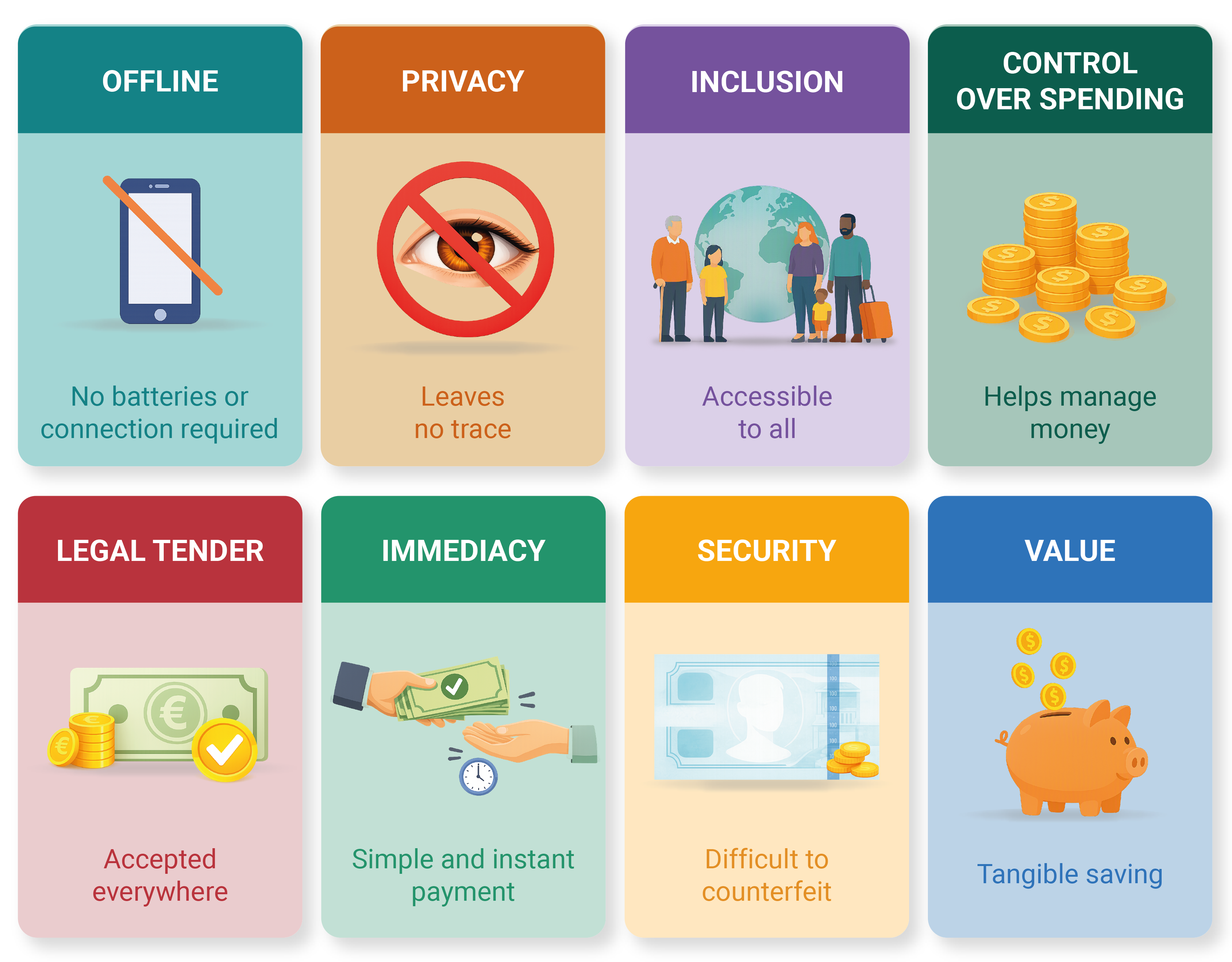
SOURCE: Devised by authors
The tangibility of cash, a feature that no other means of payment can replicate, makes us more aware of our spending and helps to curb impulse buying
Other means of payment offer benefits of their own. The digital euro, for example, will share many of the benefits of cash. What matters is that physical and digital payment options exist side by side, ensuring that individuals can choose the method that best suits their needs and preferences.
What would cashless society look like? A journey into the future
A cashless future is far from an inevitable outcome, and presents significant risks from both a technical and a social perspective.
Picture a future, in the style of Verne or Asimov, with no banknotes or coins, where only digital means of payment exist. For such a system to work, the technological infrastructure would have to be exceptionally robust, ensuring uninterrupted connectivity and protection against failures and cyberattacks, even in critical situations and disaster scenarios.
Yet even with foolproof cybersecurity and universal connectivity, cash would still be indispensable. Physical money should not be seen as a relic of the past, but as a safety net, as essential as fire extinguishers in a smart digital building or staircases in a skyscraper.
Moreover, this vision of a cashless future risks leaving certain groups behind, such as unbanked individuals and those with limited digital skills.
Physical money is a safety net, as essential as fire extinguishers in a smart digital building or staircases in a skyscraper
Is there a point of no return?
The shift from a cash economy to a cashless one is far from inevitable. However, the further the process advances, the harder it is to reverse course. The process does not unfold automatically, but every step, whether forward or backward, comes at a cost.
The ability to access cash easily should not be taken for granted. Maintaining the cash infrastructure – printing works, mints, distribution networks, cash-in-transit services, ATMs and bank branches – is complex and costly. As cash use declines, the cost per transaction rises, reducing efficiency and putting the continuity of cash services at risk. If cash falls out of everyday use, the infrastructure needed to produce and distribute it would have to be scaled back. But, in a critical situation, we could then find ourselves without a sufficiently dense network to guarantee access to cash.
The case of Sweden is very illustrative. Once expected to become a cashless country by 2025, Sweden has changed course. The Swedish authorities – both the government and the central bank – have now passed legislation to protect cash and are encouraging its regular use and advising households to keep some at home as a precautionary measure.
DID YOU KNOW ...?
Sweden has come closer than any other country to eliminating cash.
- The initial plan: becoming the world's first cashless society
- For years, Sweden was the global testing ground for digital payments.
- Many shops stopped accepting banknotes.
- Banks gradually removed cash from their operations.
- The value of banknotes in circulation had almost halved since 2008.
- 2024-2025. The rethink: the system had gone too far
- Emergencies and crises showed that when the network fails, payments grind to a halt and, without cash, buying food, medicines or fuel can become almost impossible.
- Older people, rural communities and migrants went from vulnerable to excluded.
- The correction: bringing cash back into everyday life
- A legal obligation for supermarkets and pharmacies to accept cash.
- A requirement for banks to allow cash deposits.
- The key message: cards, mobile payments and cash must coexist.
- Official recommendation: keep around 1,000 Swedish kronor (just under €100) per adult at home for emergencies.
The ECB also recommends keeping some cash at hand, highlighting the unique role that cash plays in times of crisis – as we saw during the blackout in Spain. It is always advisable to carry cash on you and keep some at home to cover essential expenses for a few days. The amount will depend on each household’s needs and size; authorities generally suggest enough for around 72 hours. Small-denomination banknotes and coins are particularly useful for everyday payments.
The future of payments may be predominantly digital, but cash remains an essential part of the journey: a key component of the economic system, a public right and a safeguard against technological failures and financial exclusion. Maintaining cash alongside the digital euro would help ensure an environment in which public and private, physical and digital means of payment coexist, preserving freedom of choice, system resilience and inclusion for all.
The success of our payment system will not be measured by how quickly we do away with physical money, but by our ability to preserve the efficiency of digital payments and the safety net of physical payments
Technological progress does not have to mean replacement; it can mean adding something new to the mix. The success of our payment system will not be measured by how quickly we do away with physical money, but by our ability to preserve a hybrid model in which the efficiency of digital payments and the safety net of physical payments coexist. As Asimov might have put it, technology should serve human beings, without curtailing their autonomy or leaving anyone behind.


DISCLAIMER: The views expressed in this blog post are those of the author(s) and do not necessarily coincide with those of the Banco de España or the Eurosystem.