The Banco de España and Latin America: the new LatAm Economic Forum as a strategic initiative
Latin America is a core area of focus for the Banco de España, given its importance for Spain’s economy and banking sector. This is reflected in our analysis of the region and in our international cooperation with its central banks and key institutions. The first LatAm Economic Forum further advances this strategic priority.
In an increasingly interconnected world, a sound understanding of developments outside Spain is key to safeguarding our monetary and financial stability. To this end, the Banco de España closely monitors the economies most relevant to Spain and collaborates with their institutions. Latin America is a strategic priority for the Banco de España, and the LatAm Economic Forum marks another step forward in this respect. In this blog post, we explain our work with the region and the event recently held in Roda de Bará, near Tarragona.
Latin America as a strategic priority for the Banco de España
Latin America is a key region – and undoubtedly the most important one outside Europe – for Spain’s economy and banking system. Since the 1990s, Spain has maintained very close economic ties with Latin America through banking and investment, and trade with the region has also grown in parallel. Moreover, since the turn of the century Latin America has become the main source of immigration to Spain. Figure 1 illustrates the region’s importance for the Spanish economy.
Figure 1
HOW IMPORTANT IS LATIN AMERICA FOR THE SPANISH ECONOMY?
SOURCE: Banco de España.
NOTES:
-The bank exposure data refer to 2024 and those on earnings to 2025.
-The trade data correspond to 2025 and those on direct investment to the stock up to that year.
-The immigration data correspond to 2025 and those on remittances to the period 2013-25.
DID YOU KNOW ...?
- Around 25% of Spanish banks’ total assets
 are located in Latin America, notably in Mexico and Brazil, and in 2025 the region accounted for half of the earnings of the two main Spanish banks operating there.
 - 30% of Spain’s foreign direct investment is held in Latin America, specifically Brazil and Mexico. As regards foreign investment in Spain, 5% of the total comes from the region, chiefly from Mexico.
- Latin America accounts for around 6% of Spain’s trade in goods and services.
- By 2025, over 4.5 million Latin Americans had moved to Spain, representing almost half of the country’s immigrants and 9% of its registered population, with Colombia as the main source country of immigration from the region.
- 60% of remittances from Spain were sent to Latin America between 2013 and 2025. Colombia is the leading destination for Spanish remittances, and seven Latin American countries are among the top ten.
For all these reasons, the Banco de España closely monitors and analyses the Latin American economies, making us the reference Eurosystem central bank on the region.
DID YOU KNOW ...?
- Our flagship publication on the region is the twice-yearly Report on the Latin American economy, covering economic and financial developments since 2003.
- In the latest edition of the report, published in late April, we highlight the region’s resilience in a difficult geoeconomic environment and assess the outlook amid the Middle East conflict.
- In the latest edition of the report, published in late April
- Also twice a year, since the second half of 2023 we have released vulnerability indicators for the emerging market economies that are most relevant for the Spanish banking system, most of which are in Latin America.
- Every month, we update the economic policy uncertainty (EPU) indices for 18 Latin American countries, developed by our researchers.
- We have also published numerous analytical and research articles covering current issues such as the effects of free trade agreements between the EU and Latin American countries.
- Lastly, we organise events focused on the region, most notably the Latin American Analysis Forum, which is held twice a year and has already met 22 times.
The importance we attach to Latin America is also reflected in our international cooperation with peer institutions, be they central banks, supervisors or international financial organisations. Such cooperation is common among central banks, as it enables us to exchange valuable knowledge and experiences and to forge links that help us better fulfil our functions.
Latin America is a strategic priority for the Banco de España. The new LatAm Economic Forum strengthens that commitment
How does this cooperation take shape? It can be either bilateral or multilateral. Multilateral cooperation typically takes two forms:
- through organising activities aimed at a broad range of institutions, for example meetings of experts in different areas of central banking; or
- through our experts participating in activities promoted by international organisations or institutions, such as training courses for supervisors or other central bank staff.
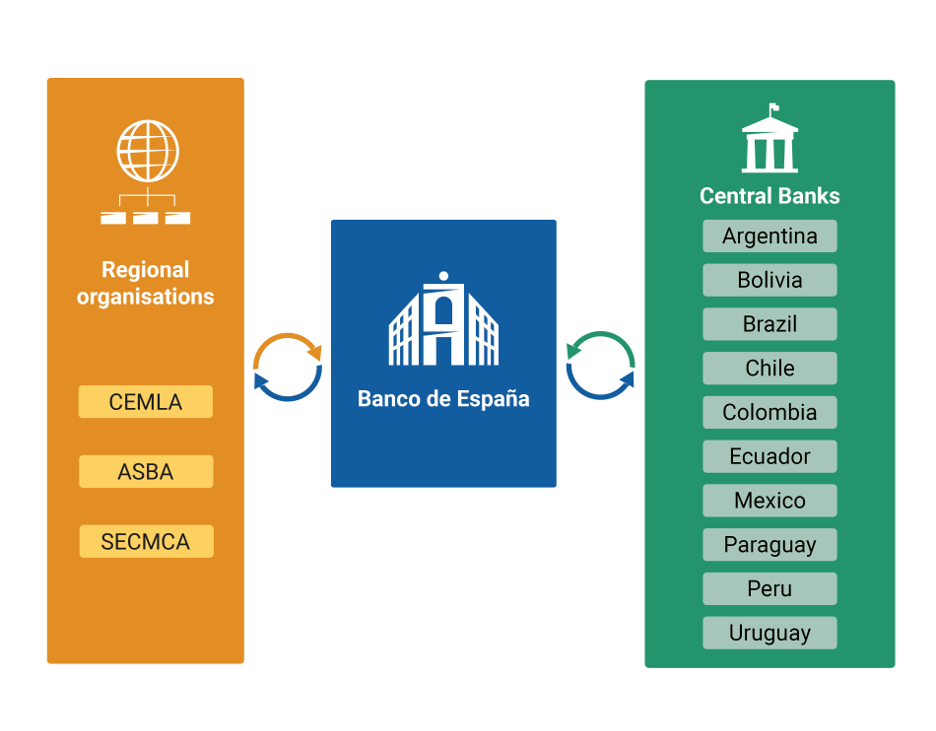
We cooperate mainly with the Center for Latin American Monetary Studies (CEMLA), the Association of Supervisors of Banks of the Americas (ASBA) and, in Europe, the European Central Bank (ECB). Figure 2 summarises our collaborative links with Latin America.
Figure 2
THE BANCO DE ESPAÑA’S MAIN COOPERATION PARTNERS IN LATIN AMERICA
SOURCE: Banco de España.
NOTES:
-CEMLA= Center for Latin American Monetary Studies; ASBA= Association of Supervisors of Banks of the Americas; SECMCA= Executive Secretariat of the Central American Monetary Council.
-The central banks listed are those with which cooperation agreements are currently in force in the regio
DID YOU KNOW ...?
- Since it was established in 1952, CEMLA has served as the regional association of central banks, with Spain playing a very active role. Today, CEMLA brings together 29 associate central banks and 18 collaborating institutions, including ten other central banks.
- The Banco de España has worked closely with CEMLA since joining as a collaborating member in 1965. In 2021, it became an associate member, strengthening that commitment even further. Since May 2023, the governor of the Banco de España has chaired CEMLA’s Board of Governors.
- Alongside our work with CEMLA, we have cooperation agreements with ten Latin American central banks, and more are currently under way, including one with Venezuela. We also have agreements with three other regional institutions: the Latin American Reserve Fund (FLAR), the Development Bank of Latin America and the Caribbean (CAF) and the Executive Secretariat of the Central American Monetary Council (SECMCA). These agreements help structure and consolidate institutional cooperation.
- We also collaborate with the Latin America departments at the World Bank and the International Monetary Fund.
The Banco de España prioritises Latin America in its cooperation work. In 2025, it carried out 263 international cooperation activities, and 137 of them (52%) were directed exclusively at institutions in the region. Another 48 activities (18%) also involved Latin American institutions, together with participants from other parts of the world.
In 2025, more than half of the Banco de España’s international cooperation activities involved Latin America
The new LatAm Economic Forum
The Latin American Economic Forum reinforces our strategic commitment to the region. It was established with a clear purpose: to bring central bank governors and outstanding economists together regularly to analyse and discuss the main economic challenges facing Latin America.
DID YOU KNOW ...?
The world's leading central banks – the Federal Reserve System in the United States and the European Central Bank – organise similar fora, although these are not focused on any specific region:
- The Jackson Hole Economic Policy Symposium has been held every August in Wyoming, near the Rocky Mountains, since 1982.
- The ECB Forum on Central Banking – the Sintra Forum – has been held annually in the Portuguese town of Sintra since 2014.
- The first edition of the LatAm Economic Forum took place on 8 and 9 May 2026 at the Banco de España’s facilities in Roda de Barà (Tarragona).
The Forum’s agenda was shaped by global uncertainty, geopolitical tensions and technological change. The topics covered included capital flows and exchange rates, tariffs, geoeconomics and digital payments.
The opening address was delivered by ECB President Christine Lagarde, who spoke about the future of money and stablecoins. In his closing remarks, Governor José Luis Escrivá, who hosted the forum, underlined the importance of these events in helping address economic policy challenges. He pointed out that stronger monetary policy frameworks had made Latin America more resilient, but warned against complacency and called for closer cooperation and stronger institutional ties.
The Forum has been a real success and looks set to continue. In a time of change and uncertainty, dialogue between central banks − backed by solid academic analysis − matters more than ever.



DISCLAIMER: The views expressed in this blog post are those of the author(s) and do not necessarily coincide with those of the Banco de España or the Eurosystem.