
How do we pay when the power goes out? Spain’s blackout experience
In critical situations, when the alternatives stop working, cash becomes even more valuable and helps us carry on. Coins and banknotes have proved their worth as an independent, widely accepted and reliable means of payment that enables us to continue making our daily purchases even in extreme circumstances like last year’s blackout.
27/04/2026
One year ago Spain experienced a blackout that lasted almost 24 hours in some places. In such a critical situation, when everything stopped working, cash helped us get through the emergency. What advantage does cash have in these situations? How did the Banco de España manage the situation? What lessons have we learned for the future? And, if ultimately adopted, would a digital euro be available during a blackout?
I lived through the blackout! And cash helped us get through it
Monday 28 April 2025, 12:33 p.m. What began as a normal day quickly turned into an extraordinary one: the power went out, many mobile phones lost coverage, connections failed and, while some devices continued to work, many others didn’t.
In the first few hours of the blackout, there was little information about what was happening, but we sensed that the situation was serious. We had already experienced several traumatic events – such as the pandemic, the 2024 flash floods – but this was something new. We have grown used to living and working in an interconnected society, and this connectivity requires power.
With the blackout, electronic payments – an increasingly common part of our day-to-day lives – simply stopped working. Some ATMs ran out of banknotes while others, despite still having cash available, went out of service as they had no back-up battery or network connectivity.
DID YOU KNOW ...?
- In Spain, cash remains the most widely used means of payment at physical points of sale. According to our annual Study on Cash Use Habits, 57% of people used it every day in 2025.
- However, other means of payment, such as cards (28%) and, particularly, mobile devices (16%) are gaining ground. And these need electricity to work.
How we each experienced the blackout depended greatly on how we were able to overcome the problems it brought, made even more challenging as at first we had no idea how long it would last. Simple activities like buying essentials (such as medicines or food) and getting home from work became much more difficult due to our reliance on electronic means of payment, which were suddenly unavailable. Cash, of course, could not bring back the power, but it did make our lives easier in the meantime.
Cash ensures autonomy, as it’s the only means of payment currently available that doesn’t require access to equipment, electricity or the internet
Cash (euro banknotes and coins) is a means of payment with many advantages. For example, it ensures privacy, it’s inclusive, it helps us keep track of our expenses, it’s secure and it serves as a store of value.
But the blackout highlighted two additional advantages of cash:
- It’s fast: it settles a payment instantly.
- It ensures full autonomy: banknotes and coins are the only means of payment that don’t require access to equipment, electricity or the internet.
What did the Banco de España do to ensure that cash remained available?
The Banco de España is well aware of how important cash is in crisis situations like this one. From the outset, the Bank was in the fullest contact possible with its branch network and the private agents that distribute cash around the country (banks and cash-in-transit companies). The aim was threefold:
- to ascertain the operational status of ATMs;
- to work with these agents to coordinate management of the most critical ATMs;
- to offer extended opening hours at branch offices should agents need it.
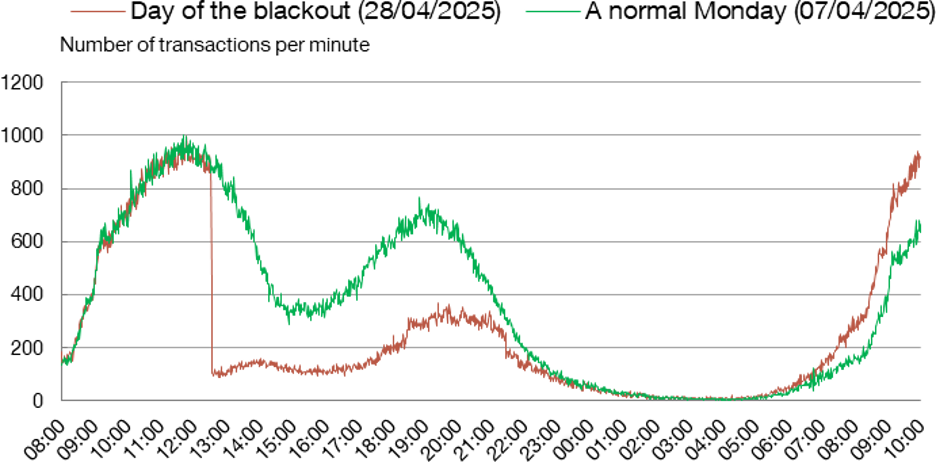
As Chart 1 shows, the number of ATM withdrawals plunged at the exact moment the blackout hit. The ATMs equipped with battery power and network connectivity ran out of banknotes, while others went out of service, despite still having cash available. The day after, once the power and connectivity had been restored, there was a sharp increase in cash withdrawals.
Chart 1
ATM WITHDRAWALS PLUNGED ON THE DAY OF THE BLACKOUT
SOURCE: Redsys.
The extensive network and service hours of the cash distribution system were key to ensuring a quick return to normal
On 29 and 30 April (the two days following the blackout), banks and cash-in-transit companies carried out a massive restocking of ATMs, giving priority to those in key locations. As part of this effort, they collected cash from the Banco de España –15% more than on the same days in 2024 – in a process closely overseen by the Bank.
What if there’s another blackout?
As with the other emergencies that we have regrettably faced in recent years, the blackout offers some lessons for the future.
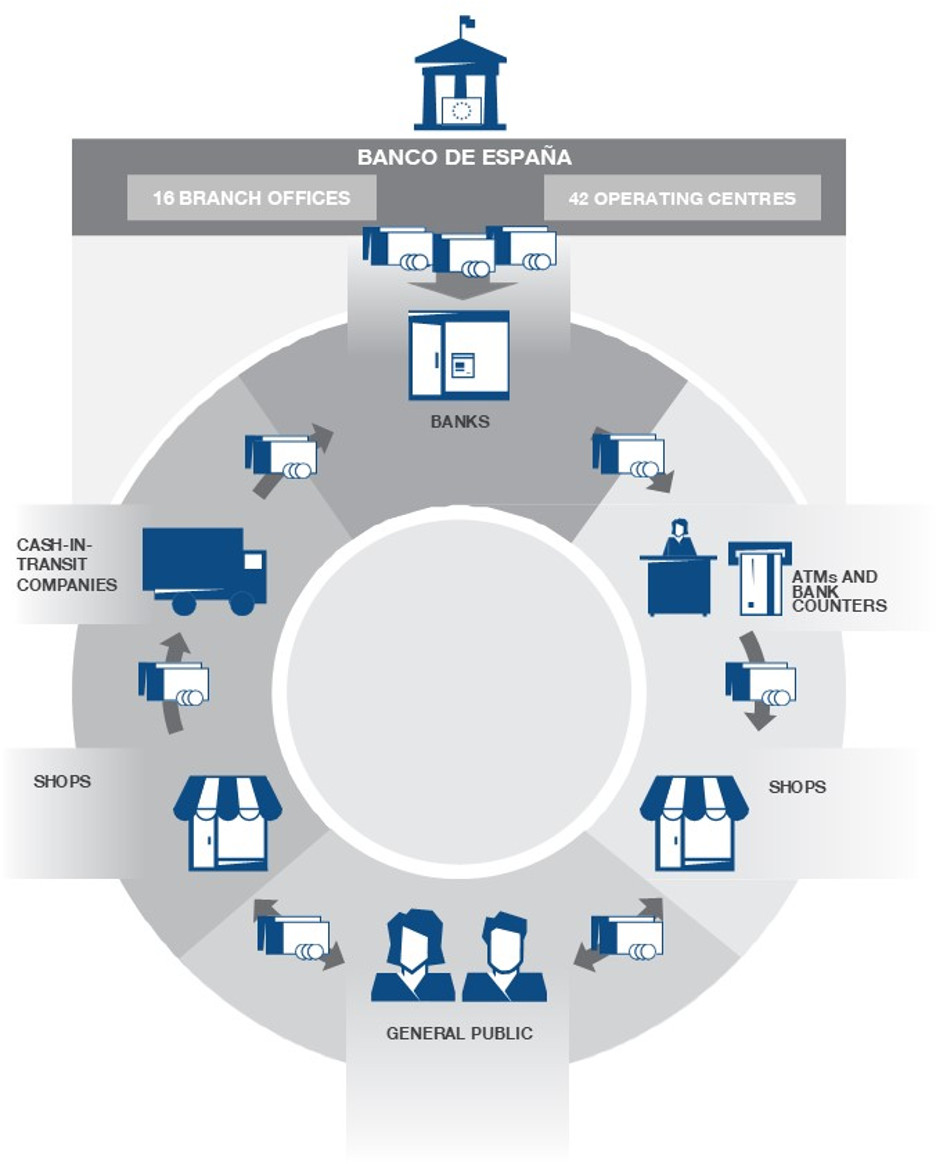
First, it is worth taking stock of the capacity of the Banco de España’s cash distribution system (Figure 1). This system operates through the Bank’s network of 16 branch offices and an external network of 42 operating centres within the ancillary deposit system. The blackout showed how the system’s large network, along with the operating centres’ extensive service hours, enables the cash safeguarded by the Banco de España to reach end consumers (the general public, firms and banking agencies) quickly and efficiently.
Figure 1
HOW CASH IS DISTRIBUTED AND CIRCULATED
SOURCE: Banco de España.
Second, we should acknowledge the effective work to manage and prioritise activities that was carried out by banks and cash-in-transit companies, as well as how the Banco de España teams in Madrid and at branch offices monitored the situation.
These factors were key to ensuring that services, particularly ATM-related services, returned to normal.
This was all made possible by agents’ ongoing efforts to improve cash distribution channels and define business continuity procedures, thus helping to mitigate the impacts of such events. Situations like these also help us strengthen our responsiveness, in a coordinated manner, across our respective areas.
In any event, to lessen the impact of similar situations in the future, it’s a wise idea to have a small amount of cash on hand for immediate purchases of essential goods and services.
DID YOU KNOW ...?
In an article looking at the blackout in Spain and other such events, the European Central Bank provides some guidance on how to prepare for similar crises.
- Central banks, finance ministries and civil protection agencies in a number of countries suggest having €70-€100 in cash per household member, or enough to cover essentials for 72 hours.
Solutions are being incorporated into other means of payment, so they can be temporarily used while offline or even when there’s no power.
- If ultimately adopted, the digital euro, designed to complement cash and provide a similar user experience, would support payments in such situations via an offline wallet applet.
We can’t be certain there won’t be another blackout or similar event in the future. But we are working to ensure that – should one happen – cash’s role as a swift and autonomous means of payment continues to be acknowledged and valued among society. The advice is simple: “Just make sure to have some cash on you and at home”.

DISCLAIMER: The views expressed in this blog post are those of the author(s) and do not necessarily coincide with those of the Banco de España or the Eurosystem.