When the Banco de España is your office and Europe your team (or vice versa)
Europe was not born out of treaties and acronyms but from a simple yet bold idea: to work together to prevent war. This is the idea at the heart of the 1950 Schuman Declaration. At the Banco de España, we understand this as sharing projects and aligning perspectives with colleagues from many countries – different accents and cultures and countless hours of analytical work. Because Europe is built by working together, day by day.
Today it is easy to take Europe for granted as a shared project that is part of everyday life. Yet our united Europe, based on cooperation, is the result of a deliberate choice made at a very different moment in history.
After two world wars with the continent at the epicentre, on 9 May 1950 Europe embraced a deeply innovative idea for its time: to build peace through practical cooperation between countries. By pooling the strategic resources of former rivals – the heavy industries of France and Germany – war would become “not merely unthinkable, but materially impossible”.
This was the cornerstone of the Schuman Declaration and of the European project itself, which was built around a key idea: “Europe will not be made all at once, or according to a single plan. It will be built through concrete achievements which first create a de facto solidarity”. To look back on Schuman’s words is to return to the very origins of the European project and of Europe Day. 76 years later, that same spirit – cooperating to move forward together, step by step – remains the driving force behind the project and a tangible reality in the work of European institutions, including here at the Banco de España.
But how did we get from that vision to today’s Europe? In what ways has Europe shaped people’s lives, economically and socially? Do institutions, and central banks and supervisors in particular, truly cooperate? And how do the people who work in them, including those of us at the Banco de España, experience the European project?
Europe will not be made all at once, or according to a single plan. It will be built through concrete achievements which first create a de facto solidarity
Europe: a brief history
The European project was built brick by brick, through decisions aimed at working together in the very areas that had once been sources of conflict. The creation of the European Coal and Steel Community – which placed key war resources under a single production and management system – marked its starting point.
These first European communities were followed by a succession of agreements and treaties that steadily expanded the scope of joint action, leading to the levels of economic and political integration we now enjoy in the European Union (EU) – a journey illustrated in Figure 1.
Figure 1
MILESTONES IN EUROPEAN INTEGRATION (interactive content: click ┼ for more information)SOURCE: Banco de España.
The Treaties have sought to put into practice the core legacy of Schuman and other founding fathers such as Jean Monnet and Konrad Adenauer: a new way for States to engage with one another, based on trust, shared institutions and mutual interests.
The will to cooperate: achievements
This cooperation model has brought great progress across many aspects of our everyday lives as Europeans:
- As citizens, we can move freely within the European Union and share a common currency.
- As students, we can access European training programmes like Erasmus.
- As workers, we enjoy freedom of movement and equal working rights across the EU.
- As consumers, employers and producers, we operate within a single market for goods and services.
- As savers and investors, we have a strong single currency and free movement of capital.
- As bank customers, we benefit from easier and cheaper payments, shared benchmarks for financial transactions (for example, the EURIBOR) and more secure and competitive banks.
Europe’s economic and financial stability is a common good. In a geopolitical and economic context shaped by international tensions, uncertainty and common challenges (such as technological change, demographic shifts and the climate crisis), cooperation among institutions is key to strengthening strategic autonomy and addressing unavoidable challenges.
A new way for States to engage with one another, based on trust, shared institutions and mutual interests
New institutions to move forward together
Numerous European institutions, bodies and agencies work to serve the common interests of the European Union and European citizens. The Institutions of the European Union set the priorities and make it possible to move forward in lock step.
DID YOU KNOW ...?
The Treaty on European Union establishes which bodies are considered “Institutions of the European Union” and provides that they “shall practice mutual sincere cooperation”. Together, they define the broad lines of the EU’s common policies. There are seven EU institutions:
- The European Parliament
- The European Council
- TheCouncil of the European Union (or Councils of Ministers)
- The European Commission
- The Court of Justice of the European Union
- The European Court of Auditors
- And, in the monetary and financial sphere, the European Central Bank.
The European Central Bank (ECB) sets monetary policy for the euro and plays a key role in banking supervision in Europe, working alongside the national central banks of European Union Member States (which form the European System of Central Banks) and the national supervisors within the Single Supervisory Mechanism (SSM). A core group is responsible for monetary policy and other important issues: the Eurosystem, which comprises the ECB and the central banks of the countries that use the euro, including the Banco de España.
The Banco de España’s place within European cooperation
The Banco de España collaborates daily with the ECB and the other national central banks, working in teams at all levels. Cooperation starts with technical work – comparing data, sharing analyses, testing hypotheses – and trickles up through working groups and committees until it reaches the decision-making bodies (at the highest level, the Governing Council, i.e. the governors of the Eurosystem national central banks and the members of the ECB Executive Board).
Cooperation isn’t some abstract concept; it’s a daily practice. It’s discussing and building common positions, in virtual and face-to-face meetings, to adopt consistent and better-informed decisions in our core areas: price stability, financial stability and the smooth functioning of the euro area economy.
The Schuman Programme: Europe “in the flesh”
This collaborative spirit is also reflected in the professional opportunities available to central bank staff across Europe. The Schuman Programme is one example. It allows us to collaborate directly on projects or common initiatives through secondments to other euro area central banks or supervisors and to experience working in another country.
DID YOU KNOW ...?
14 institutions and 37 individuals took part in 35 projects in the first edition of the Schuman Programme in 2017. The Banco de España has participated in every edition since.
In the seventh edition (2025/2026), the Banco de España:
- published four projects, for which there were 34 candidates.
- selected projects focused on strategic areas: transparency, Eurosystem collateral management, cash security and market infrastructures.
- welcomed staff from the Deutsche Bundesbank, the Bank of Greece, the Banco de Portugal, Banca Naţională a României and the ECB.
With so many personal and institutional advantages (Figure 2), these secondments and professional collaborations make one thing clear: programmes like this are the way forward, and we achieve more when we work together.
Figure 2
ADVANTAGES OF THE SCHUMAN PROGRAMME
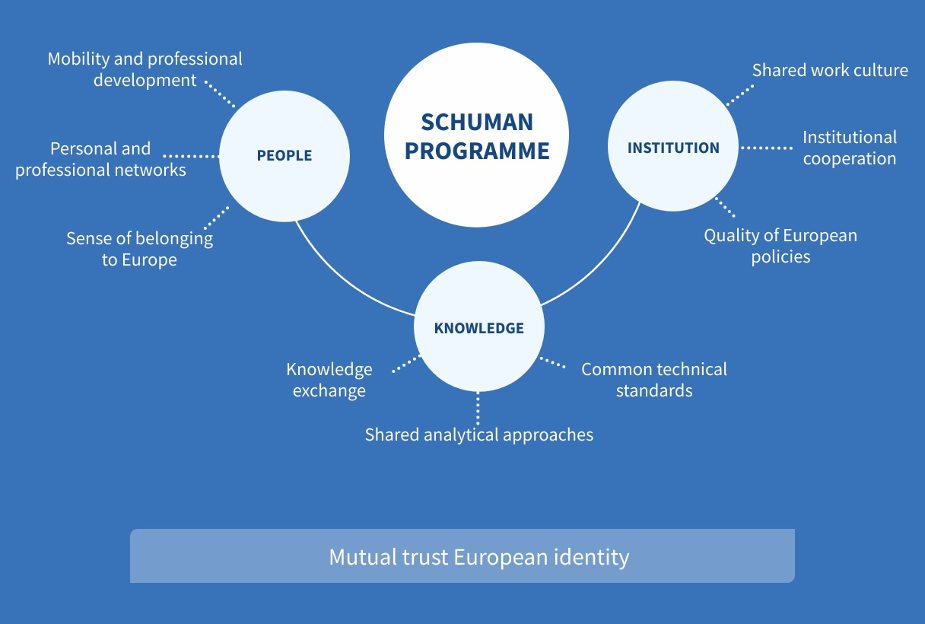
SOURCE: Devised by authors.
Schuman Programme participants’ first-hand accounts of their experience give better insight into its impact:
"The day-to-day – meetings with different accents, hallway conversations, impromptu coffee breaks – is what will stay with me. That’s where you feel the rapport with your colleagues. Sharing our different approaches and insights proves to me that this is much more than just a professional experience".
Mihai Vasile Cirja Legal adviser at Banca Națională a României.
Schuman Programme: Transparency as a catalyst for change project, at the Banco de España.
"This was my first international experience since joining the Banco de España and I saw first-hand what a cooperation-focused work environment is like. My horizons have been broadened and I learned a lot that will come in handy for my day-to-day".
Alba Ortiz Cerezo Financial Risks Expert at the Banco de España.
Schuman Programme: ECB’s Climate Change Centre.
"There was virtually no adaptation period: from the very first meetings, switching between Spanish, Portuguese and English, communication was smooth; I felt like we were working as a single team straight away. The daily collaboration was what left the biggest mark on me. I lived the experience with the responsibility and pride of representing the Banco de España and with the excitement of building something that I could bring back with me that could add value at the Bank".
Alonso Sánchez Rodríguez General Junior Analyst at the Banco de España.
Schuman Programme: Statistics Project at the Banco de Portugal.
A single idea through time: building Europe through cooperation
Today’s Europe is not something we automatically inherited. It’s the outcome of consistent decisions and a specific way of working together. The Schuman Declaration sparked the flame of cooperation; European institutions keep it burning every day.
At the Banco de España cooperating within Europe is a daily practice. It enables us to make better decisions and tackle common challenges together, while gaining awareness and making the most of being part of this family called Europe.

DISCLAIMER: The views expressed in this blog post are those of the author(s) and do not necessarily coincide with those of the Banco de España or the Eurosystem.