
The 2026 Nobel Prize for Economics: how expectations determine stabilisation policy effectiveness
Professors Robert E. Hall and Michael Woodford have been awarded the Nobel Prize for Economics. Their research reveals how household, worker and corporate expectations determine decision-making and economic activity and how economic policy helps stabilise economic cycles and inflation. Their work underpins the models that central banks use to analyse the economy and design monetary policy.
13/10/2026
The 2026 Nobel Prize for Economics has been awarded to Robert E. Hall and Michael Woodford, both US citizens and university professors (at Stanford and Columbia, respectively). Their contributions have played a fundamental role in transforming modern macroeconomics. Although their research addresses different issues, both have helped macroeconomists answer some of the field’s most pressing questions: What role do our expectations play in the decisions we make? How do they affect economic activity? How can economic policy help stabilise the economy? Their work continues to be vital to central banks today and underpins the models they use to analyse inflation, growth and the effects of monetary policy.
From Keynes to modern macroeconomics: the role of the new Nobel laureates
Macroeconomics analyses fluctuations in economic activity, employment and inflation and examines the role economic policy plays in stabilising the economy. Economies operate in alternating cycles of expansion and slowdown that directly impact households and firms. A central task for economists, therefore, is to understand how these cycles behave, how economic shocks propagate and how demand-side policies, both fiscal and monetary, can help stabilise activity and prices.
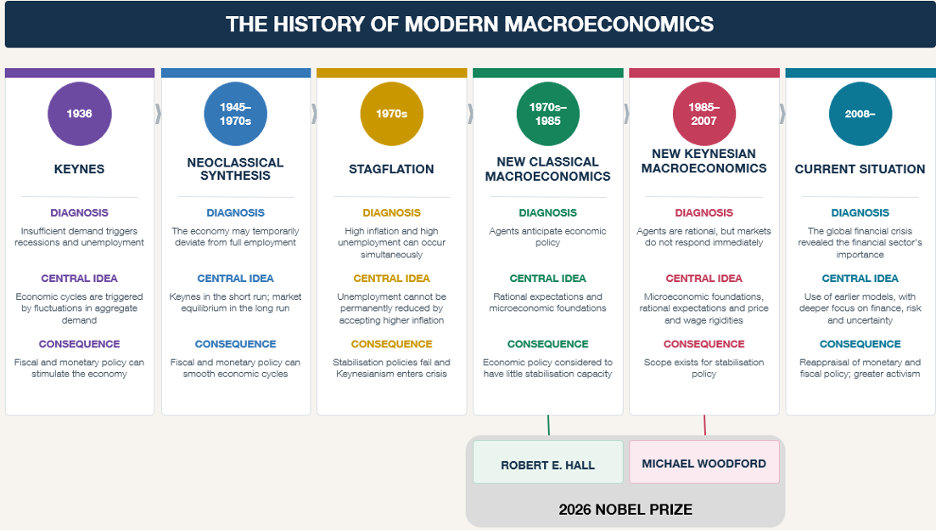
The field has evolved considerably since Keynes first laid the foundations of modern macroeconomics. Successive economic crises and new economic realities have transformed the way economists analyse how the economy functions, as illustrated in Figure 1.
Figure 1
HALL AND WOODFORD’S PLACE IN THE HISTORY OF MODERN MACROECONOMICS
SOURCE: Devised by author
DID YOU KNOW?
- The publication of John Maynard Keynes’s General Theory
 in 1936, in the aftermath of the Great Depression, revolutionised understanding of the economic cycle and highlighted the role economic policy could play in stabilising activity.
- Keynesianism held that insufficient demand could trigger recessions and unemployment and that fiscal and monetary policy could be deployed to improve the situation.
- For several decades, the so-called neoclassical synthesis, which combined Keynesian thought on short-run fluctuations with the view that markets naturally reach equilibrium in the medium-to-long term, prevailed.
- However, when demand-side policies failed to yield the expected response to the stagflation (high inflation, persistent unemployment and sluggish growth) generated by the oil crises of the 1970s, Keynesianism fell from favour and macroeconomics underwent a profound overhaul.
- In this context, a new classical macroeconomics emerged. Economists began to pay far greater attention both to the decisions made by households, workers and firms and to the role of expectations. The outcome was that macroeconomic models were given microeconomic foundations. In other words, the models took into account economic agents’ individual behaviour.
- Economic agents do not act solely on the basis of the current situation but also on what they expect to happen in the future. For instance, if we anticipate changes in taxation, inflation or interest rates, we may alter our behaviour even before those changes occur.
- Keynesian theory was adapted to fit this framework: new Keynesianism revived the role of economic policy by adding rigidities and frictions to economic models.
- The 2007–2008 global financial crisis and subsequent inflationary episodes drove further development of these models, which now place greater emphasis on financial factors and on risk and uncertainty.
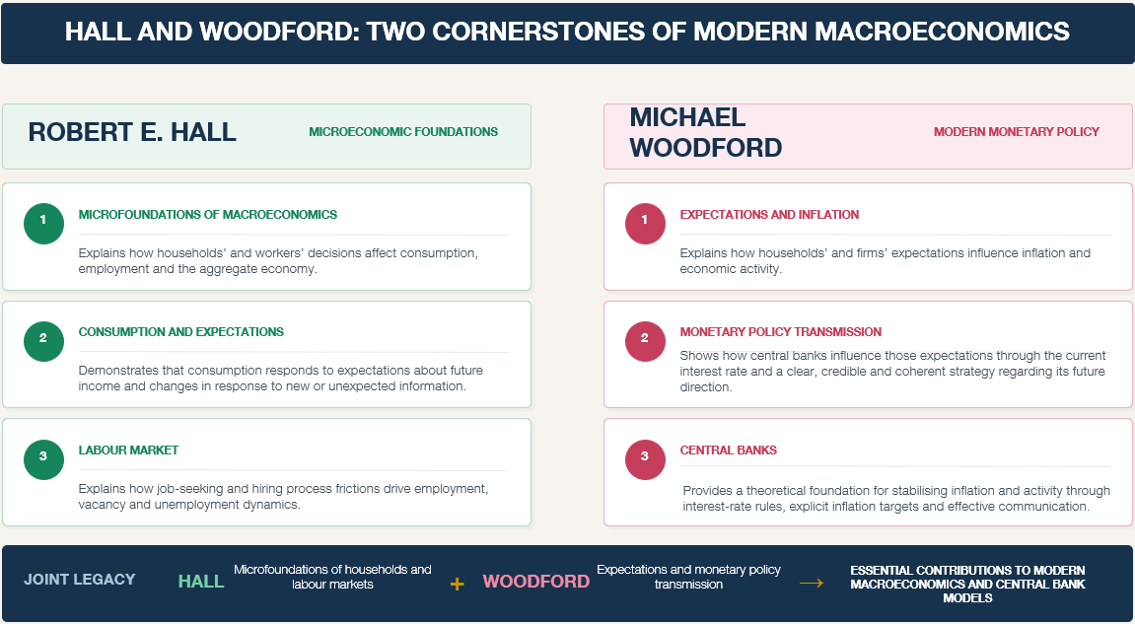
Robert E. Hall, working from the perspective of new classical macroeconomics, and Michael Woodford, doing so from that of New Keynesianism, have played a pivotal role in developing modern macroeconomics over the past fifty years (see Figure 2).
Figure 2
KEY CONTRIBUTIONS BY THE WINNERS OF THE 2026 NOBEL PRIZE FOR ECONOMICS
SOURCES: Devised by author from the work of Hall and Woodford.
Hall and Woodford’s complementary contributions have helped transform macroeconomics over the past half-century
Robert E. Hall: how agent behaviour affects the economic cycle
Professor Hall’s contributions have helped bridge the gap between individual behaviour and aggregate economic performance. His research demonstrates how households’ and workers’ decisions ultimately influence variables such as consumption, employment and economic growth.
One of his most influential contributions concerns consumption. Households do not base their spending decisions solely on the income they receive today; they also take into account the income they expect to earn in the future. In a groundbreaking paper published in 1978, Hall showed that households adjust their consumption when they receive new information that alters their expectations about future income.
This insight transformed understanding of consumer behaviour. Economic policy does not affect household spending solely through its immediate impact on income or interest rates; it also exerts influence through the expectations it generates about the future.
DID YOU KNOW?
Hall also contributed significantly to study of the labour market. His research helped explain why unemployment may persist even when the economy recovers and why hiring does not immediately respond to changes in economic conditions. To do so, he drew attention to factors such as job-seeking and hiring processes and other frictions that prevent the labour market from adjusting rapidly. His work on these mechanisms provides a more robust explanation of employment trends over the economic cycle.
Michael Woodford: how expectations determine monetary policy’s effectiveness
Professor Woodford developed a framework for understanding how monetary policy influences individuals’ and firms’ decisions and, through them, the economy as a whole.
His research demonstrates that expectations play a decisive role in determining inflation and economic activity. Firms set prices not only in response to current conditions but also in anticipation of future ones. Similarly, households make spending and saving decisions based on their expectations of future interest rates and how the economy will perform.
One of his key contributions has been to show that monetary policy operates through more than just current interest rates; expectations about their future direction are equally important. When a central bank communicates its intended course of action over the coming months or years, households and firms adjust their plans today. This, in turn, affects current consumption, investment and price levels.
Credibility and communication thus become essential elements of monetary policy. Woodford’s work explains why central bank messaging can be almost as consequential as the policy decisions themselves.
His work has provided a robust theoretical foundation for modern monetary policy frameworks based on interest-rate rules and explicit inflation targets.
Why is this Nobel Prize important for central banks?
The two Nobel laureates’ contributions complement one another. Hall’s work shed light on how households and workers make decisions and how those decisions are reflected in consumption, employment and the economic cycle. Woodford, meanwhile, explained how monetary policy influences those decisions through expectations and interest rates.
The Nobel laureates’ research forms an essential part of the models central banks use to conduct monetary policy
Many of the models central banks use are built on a simple premise: households and firms make decisions with the future in mind. Monetary policy directly influences those decisions through interest rates and the expectations it generates. The interplay between these two elements helps explain why inflation and economic activity follow a particular path. Woodford’s ideas, in particular, have had – and continue to have – an immense influence on practice at most central banks.
The 2026 Nobel Prize for Economics thus recognises two essential contributions to understanding how a modern economy functions and how public policy can act to stabilise it. Their research has deepened understanding of economic fluctuations and has enabled design of more effective policies to preserve price stability and promote our welfare.

DISCLAIMER: The views expressed in this blog post are those of the author(s) and do not necessarily coincide with those of the Banco de España or the Eurosystem.
