AI adoption in Spanish firms: the impact so far and their expectations for the future
Spanish firms, like their European counterparts, are adopting AI rapidly, although SMEs are lagging further behind. Firms using AI have so far perceived little impact on employment, but more than one-quarter report improvements in productivity and investment. While firms – above all large corporations – expect these improvements to increase, the outlook for employment is more mixed.
28/10/2026
For Spanish firms, the question is no longer whether to use artificial intelligence (AI), but how intensively and extensively to do so. As in the rest of Europe, adoption has spread rapidly over the past two years. Yet occasional or experimental use remains much more common than regular use, especially among Spanish small and medium-sized enterprises (SMEs). Public debate is often based more on perceptions than on evidence. To provide a clearer picture, we used various surveys and, in particular, the Banco de España Business Activity Survey (EBAE) to ask firms themselves how they are using AI and what effects they are observing. In this post we explain what we found.
Spain: an international comparison
Generative AI diffusion among Spain’s population is one of the highest in the world: Spain was ranked sixth in a recent Microsoft report, with 45% of people aged 15 to 64 using it in 2026 Q2.
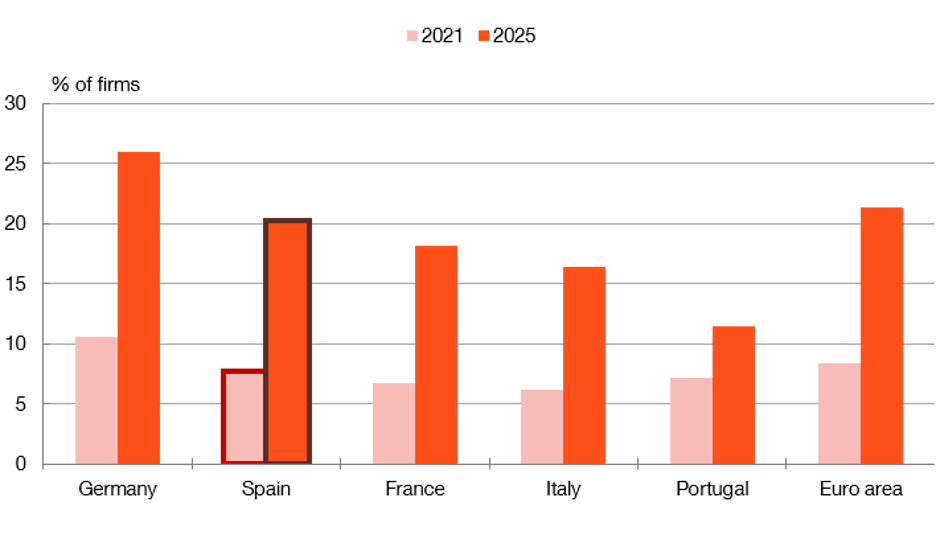
Meanwhile, the percentage of Spanish firms using AI technologies (predictive or generative AI) is similar to that of their European counterparts (Chart 1). According to Eurostat, 21% of euro area firms with ten or more employees reported using at least one AI technology in 2025, compared with 20% in Spain. Moreover, adoption has more than doubled since 2021, growing at a similar pace in the euro area and Spain.
Chart 1
FIRMS USING AI TECHNOLOGIES
SOURCE: Eurostat (ICT usage in enterprises).
The aggregate figures mask large differences by firm size. Among the largest firms (250 or more employees), adoption rates in 2025 were very similar across the major European economies, at around 57%-58% in Spain, Germany and France. Cross-country differences therefore appear to largely reflect lower adoption among SMEs. Spain is at a disadvantage here because its average firm size is smaller. The composition of the business sector may also influence each country’s adoption rate.
Compared with the United States, however, Europe appears to be falling behind. Recent evidence for the United States – albeit based on worker surveys and focused on generative AI – indicates that in 2026 around 43% of employees use it at work, compared with 26%-36% in the major European economies. Although they are not directly comparable, these figures suggest that, while rapid, AI diffusion in the workplace in Europe is lagging behind that in the United States.
Rapid and broad-based growth
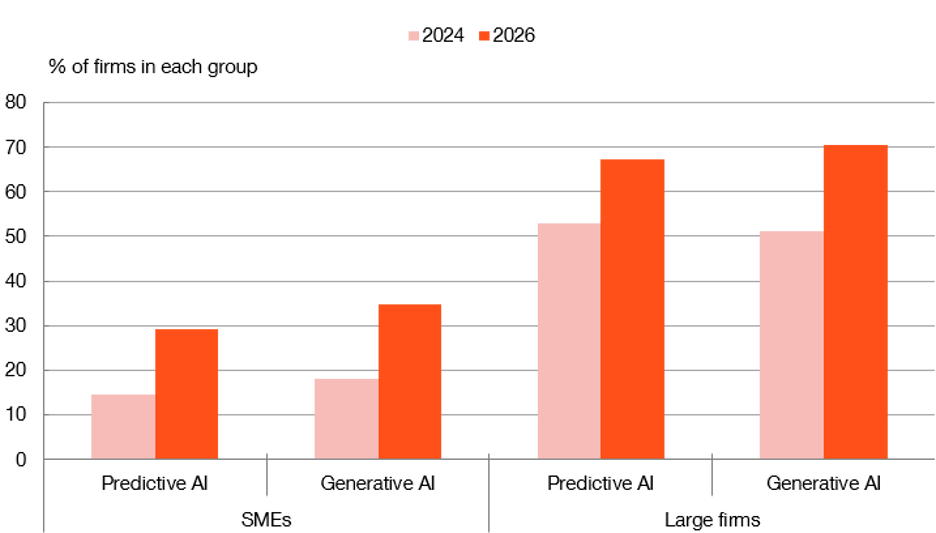
In just two years, AI use among Spanish SMEs has virtually doubled, reaching around 30% (predictive AI) and 35% (generative AI) in early 2026; among large firms, it has risen to around 70% (Chart 2). What hasn’t changed is firms’ relative position: the gap between SMEs and large firms remains as wide as in 2024, while differences across sectors have grown.
Chart 2
SPANISH FIRMS USING AI, BY TECHNOLOGY AND FIRM SIZE
SOURCE: Banco de España (EBAE).
In just two years, AI use has virtually doubled among Spanish SMEs and has risen to around 70% among large firms
DID YOU KNOW ...?
The 2024 Q4 and 2026 Q1 editions of the EBAE included questions on AI. The results tell a similar story to Eurostat's data: AI adoption is growing rapidly.
The EBAE data also make it possible to assess other aspects of AI adoption:
- SMEs and large firms are at very different stages of the process. AI adoption generally entails a learning curve, starting with experimentation and gradually progressing towards full integration into production processes. Most adopting SMEs are still at the beginning of that curve, with sporadic or experimental use being the most common. Large firms, by contrast, appear to be further along: their progress since 2024 has been concentrated at moderate or high levels of use.
- Firms report a decline in barriers to adoption alongside this rapid progress, somewhat more markedly among SMEs.
- The biggest improvements are perceived in implementation costs, the lack of skilled staff and uncertainty about legal ramifications.
- Nevertheless, the lack of skilled staff remains the most frequently cited barrier, reported by close to half of the firms surveyed.
- Why are firms adopting AI? Firms appear to use AI mainly to improve existing processes, rather than to transform what they produce.
- More than 30% of adopting firms report doing so to improve the quality or reliability of the processes underpinning their activity.
- Around one-quarter do so to automate tasks previously performed by employees or to improve production processes that were already automated.
- Other objectives, such as broadening the range of goods or services, reducing costs or increasing output and sales, are reported much less frequently.
What effects have firms observed so far and what do they expect going forward?
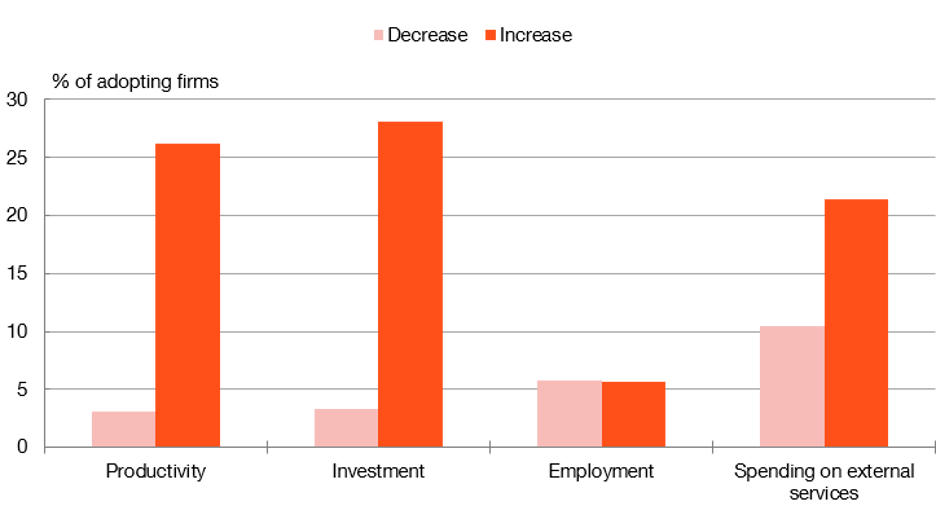
In the EBAE we asked firms about the effects they associate with AI adoption over the past three years. The results are depicted in Chart 3. AI has had a limited impact on employment so far, with close to 89% of firms reporting no significant effects on employment. Only around 6% of firms report having increased their headcount, with a similar share reporting a decrease.
Chart 3
PERCEIVED IMPACT OF AI AMONG SPANISH FIRMS
SOURCE: Banco de España (EBAE).
NOTE: The remaining adopting firms do not report significant effects on these variables.
By contrast, firms are more likely to report improvements in productivity and investment, particularly when they use these tools more regularly. More than a quarter of adopters report increases in each of these variables, compared with only around 3% reporting declines. The effect on spending on external services, such as marketing, translation or legal advice, is less clear: around 21% of firms report spending more, compared with 11% spending less.
Close to 89% of AI-adopting firms report no significant effects on employment; improvements in productivity and investment are reported more frequently
DID YOU KNOW ...?
The data on the use and effects of AI reflect firms’ own assessments and perceptions. They cannot therefore be regarded as accurate estimates of the impact of AI and should be interpreted with some caution.
Nevertheless, the results are illustrative. The effects on productivity are somewhat more moderate among SMEs than among large firms. This could be because SMEs are at an earlier stage of adoption. Among firms reporting moderate use of generative AI, close to 40% see improvements in productivity, compared with 14% of those reporting only occasional use.
This difference is consistent with the nature of this technology, whose economic impact materialises gradually as companies move beyond the experimental stages of adoption.
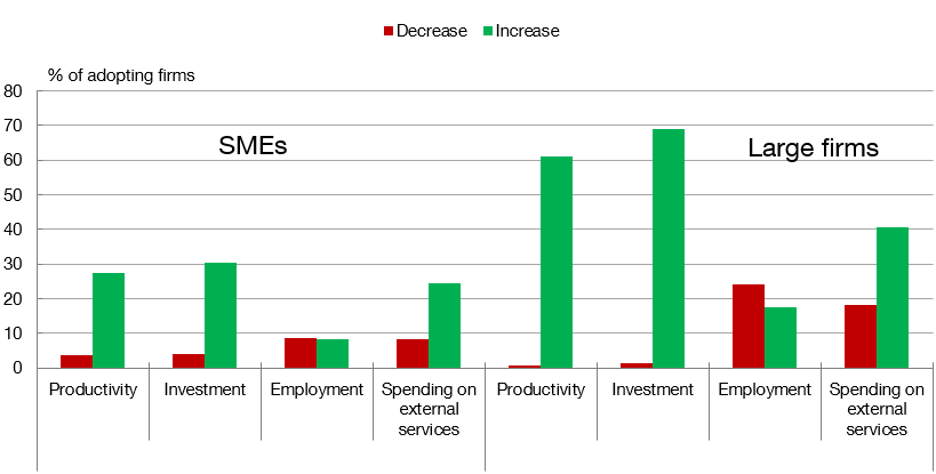
What do firms expect over the coming years? Firms expect these effects to become stronger, although expectations differ considerably by firm size. Chart 4 shows that, over the next three years, 61% of large firms expect AI to raise their productivity, compared with 27% of SMEs. The differences are similar for investment.
Chart 4
EXPECTED IMPACT OF AI OVER THE NEXT THREE YEARS AMONG SPANISH FIRMS
SOURCE: Banco de España (EBAE).
NOTE: The remaining adopting firms do not expect significant effects on these variables.
Expectations regarding employment are more mixed. Among SMEs, firms expecting increases and those expecting declines account for small and broadly equal shares of the total (8%-9% in both cases). By contrast, around 24% of large firms anticipate a decline in employment, while 18% expect it to rise. Notably, employment is the only variable where negative expectations outweigh positive ones.
What types of jobs will be most affected? Large firms expect that the hardest hit jobs will be those involving repetitive or routine tasks, with 44% anticipating a reduction in such jobs. By contrast, among SMEs, a large majority (83%) expect no changes in these types of jobs. Jobs with a greater analytical component may fare relatively better: around 20% of large firms expect employment in these roles to increase, although a sizeable share (15%) also anticipates reductions. Both groups expect management positions to be the least affected.
Firms also believe that reaping the benefits of AI will require significant organisational changes. Among large firms, 79% expect to step up training over the next three years and 62% expect to hire more specialised staff, compared with 35% and 17% of SMEs, respectively. In addition, 57% of large firms and 21% of SMEs believe they will need to allocate tasks differently within the firm. Interestingly, the firms anticipating the largest productivity gains are also those most likely to report a need for training and organisational change.
Developments that warrant closer monitoring
Spanish firms are adopting AI rapidly, but adoption remains uneven across firm sizes, a pattern also observed elsewhere in Europe and for other digital technologies. Firms, particularly large ones, expect AI to have a positive impact on productivity, while they have more nuanced expectations about employment. Whether the diffusion of these technologies boosts productivity, and whether it narrows or widens differences across firms, will largely depend on how far adoption progresses beyond the experimental stage, particularly among SMEs. This process therefore warrants close monitoring, including through quantitative analysis, to better assess the aggregate economic consequences of AI adoption, a rapidly expanding phenomenon.