The EBAE survey: how Spanish firms are performing, as reported by the firms themselves
Around 7,000 Spanish firms take part in the Banco de España Business Activity Survey (EBAE). Their responses shed light on firms’ activity, the factors influencing it and their short‑term expectations. The survey has become a valuable complement to our economic monitoring toolkit.
31/03/2026
Taking the economy’s pulse requires the fullest, most precise information possible. Typically this is drawn from economic statistics and indicators that track developments in key variables. However, such information is increasingly complemented with data gathered directly from economic agents themselves through regular surveys. The Banco de España Business Activity Survey (EBAE) is a prime example. Each quarter, firms share information on their present situation and short‑term outlook, providing insights that are more immediate and more indicative of actual business conditions than those captured by traditional statistics. It thereby bolsters our ability to monitor economic conditions and support economic analysis and policy design, in line with practices at other Eurosystem central banks.
In this post we explain what the EBAE is, how we use it and how firms can take part.
The EBAE is a cornerstone of our analysis of the economic landscape. It provides us with information directly from firms about their situation and outlook
The EBAE is a quarterly survey conducted among a large sample of Spanish firms. By responding to a questionnaire that combines standard and ad hoc questions, around 7,000 non-financial corporations share direct information on different aspects of their activity and the factors that influence it.
DID YOU KNOW…?
- The survey was launched in late 2020, during the pandemic, when alternative data sources were indispensable for gauging the economic situation.
- The questionnaire is sent to around 15,000 Spanish non‑financial corporations and has a response rate of between 40% and 50%.
- The sample is designed to be representative by sector and firm size:
- The survey covers firms across Spain and reproduces the actual structure of the country’s business sector, capturing it in considerable detail.
- Specifically, the results can be analysed for 15 sectors of activity and four firm-size categories.
- A detailed description of the methodology can be found here.
- Firms wishing to participate in the EBAE can submit an application via this contact form.
What does the EBAE tell us and why is it useful?
The EBAE captures firms’ own perceptions of how their business is performing, along with their immediate or short-term expectations (Figure 1). This information provides a qualitative, up-to-date picture of developments in turnover, employment, investment and prices, as well as the main constraints affecting day-to-day business, such as costs, labour shortages, demand and economic uncertainty.
Figure 1
THE BANCO DE ESPAÑA BUSINESS ACTIVITY SURVEY (EBAE) (Click to find out more)
SOURCE: Banco de España.
Capturing firms’ own perspectives is particularly useful for anticipating possible changes in the economic landscape and for supplementing other statistical sources, functioning as a business climate indicator comparable to those used internationally, e.g. the Purchasing Managers’ Index (PMI), but tailored to the Spanish business environment. In addition, the EBAE’s design and the information it provides set it apart from other business surveys, such as the PMI or the National Statistics Institute’s Business Confidence Indicators.
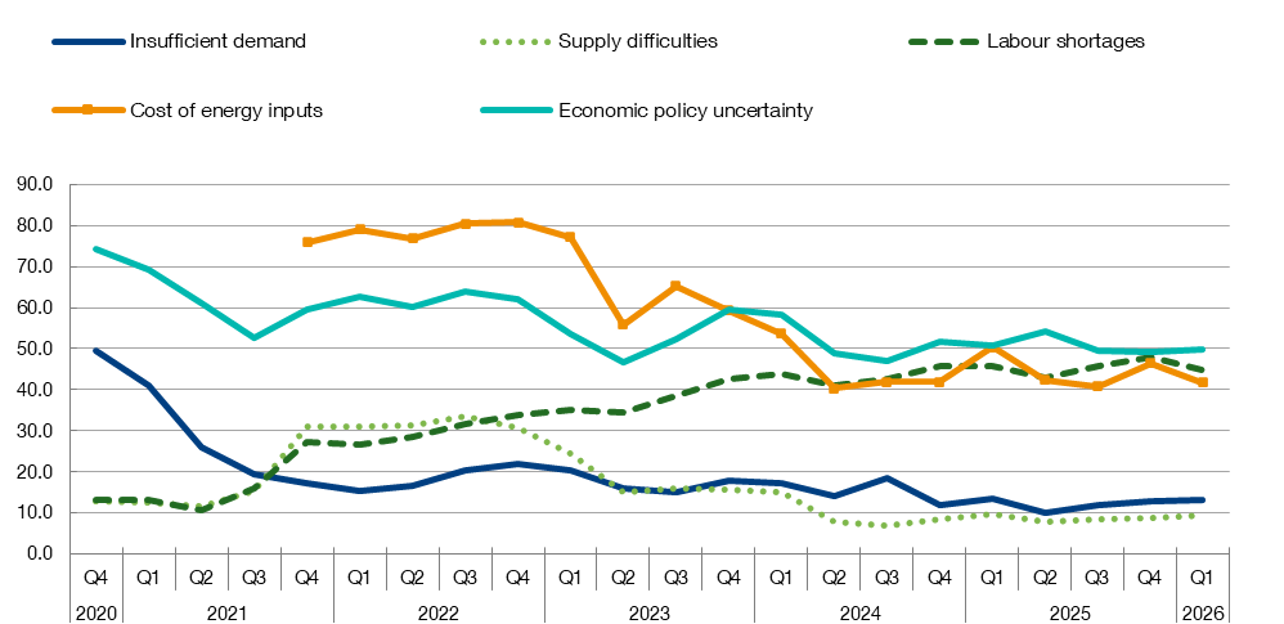
By way of example, Chart 1 shows the sizeable changes firms have perceived in the constraints on their activity over the last two years. Economic policy uncertainty and labour shortages are two constraints that they have singled out in their recent responses, including in the latest survey (2026 Q1). In comparison, other factors, such as access to finance or insufficient demand, have, on average, had a relatively smaller impact. This type of information provides better insight into business decisions at each point in time.
Chart 1
CHANGES IN CONSTRAINTS ON BUSINESS ACTIVITY
SOURCE: Banco de España Business Activity Survey (EBAE).
NOTE: Firms reporting a negative or very negative impact of each of these factors on their activity.
The EBAE’s integration with the Banco de España’s Central Balance Sheet Data Office allows us to combine detailed economic and financial information and the structural data that that survey provides with the perceptions of the firms themselves, without increasing the reporting burden for survey respondents.
One of the EBAE’s big advantages is the possibility of incorporating ad hoc topical modules into the survey. This flexibility means we can monitor the impact of shocks or any other emerging issues (Figure 1). For example, the 2025 Q2 survey included an ad hoc module on the potential impact of US tariff policy and the strategies Spanish firms planned to adopt in response. This type of evidence is key to assessing macroeconomic risks and how they could affect prices, trade and business activity.
One of the EBAE’s great advantages is the ability to incorporate ad hoc modules into the survey, enabling us to monitor and anticipate emerging risks and issues
Another great advantage of the EBAE is the scope for coordinating and comparing information with similar surveys conducted by other Eurosystem central banks. For instance, Germany, France and Italy have surveys that gauge business confidence in their respective countries. This provides us with coordinated and simultaneous information on issues of common interest that we can compare across countries. For example, the 2024 Q4 survey included a module on artificial intelligence, enabling a comparison of the use of different AI technologies across the four countries’ firms.
A survey for understanding today and anticipating tomorrow
In short, the ability to adapt the EBAE and incorporate new topics makes it a particularly useful tool for analysing the Spanish economy’s current and future challenges. From unexpected shocks to structural transformations, the survey will continue to provide crucial insight into how firms respond and how the economy is faring.


DISCLAIMER: The views expressed in this blog post are those of the author(s) and do not necessarily coincide with those of the Banco de España or the Eurosystem.