
Spain’s regulatory complexity: a drag on business and economic growth
The quality of the regulatory framework influences economic growth. Spain’s dense and fragmented regulation drives up costs and hinders entrepreneurship. Greater regulatory consistency and simplicity could foster a more dynamic, efficient and inclusive business landscape, particularly for small firms and new entrepreneurs.
The institutional landscape in which firms operate plays a key role in economic development. The quality of institutions – and the regulatory framework in particular – has a direct bearing on a country’s growth capacity, as we discussed in our last annual report . Regulations are essential for orderly economic activity and, when well designed, can correct market failings and foster sustainable growth. However, when regulations pile up without sound planning or grow overly complex (e.g. due to regional fragmentation), they can act as a barrier to entrepreneurship and hinder the growth of firms and the broader economy. So, what’s the situation in Spain?
Unprecedented regulatory proliferation
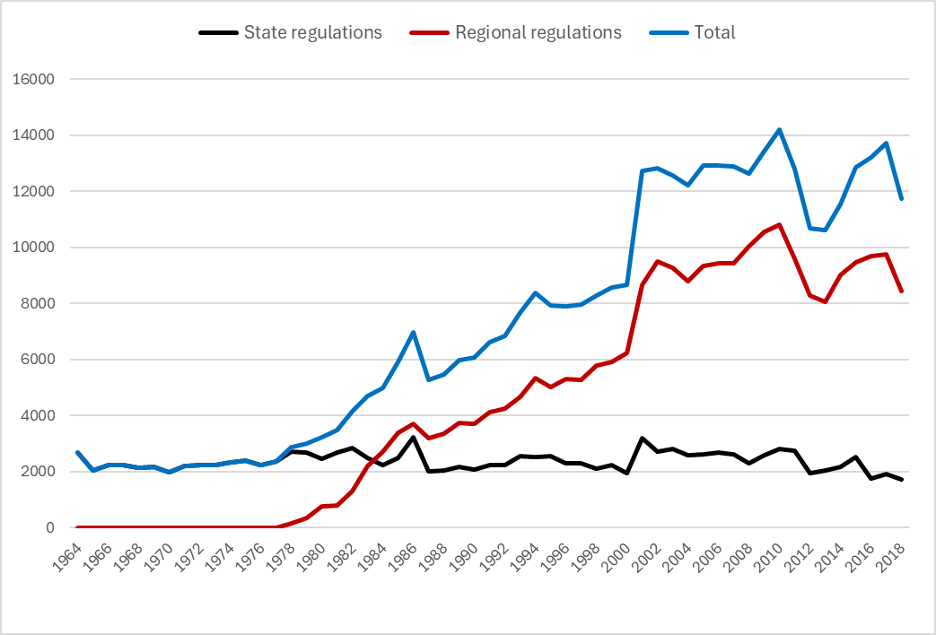
Since the transition to democracy, Spain’s legal system has produced more than 400,000 new regulations. What’s more, regulatory activity has followed a rising trajectory, as Chart 1 illustrates, alongside a growing number of cross-references between rules.
Chart 1
IN SPAIN, THE NUMBER OF REGULATIONS HAS SURGED IN RECENT DECADES
SOURCE: Mora-Sanguinetti (2022)
DID YOU KNOW ...?
- Between 1979 and 2021 Spain’s different tiers of government approved 411,804 regulations.
- In 2022 alone 11,775 new rules were adopted, equivalent to 32 each day or one every 45 minutes.
- The number of regulations issued each year has quadrupled since the democratic transition.
This proliferation is largely due to the rapid development of a regulatory framework in a decentralised state under construction, coupled with the transposition of European directives. However, it poses operational challenges for firms, particularly small ones. Businesses and entrepreneurs face a growing administrative burden and potential uncertainty or inconsistency in the regulatory landscape.
More than 30 rules are published each day in Spain. Moreover, there is much heterogeneity across regions and sectors
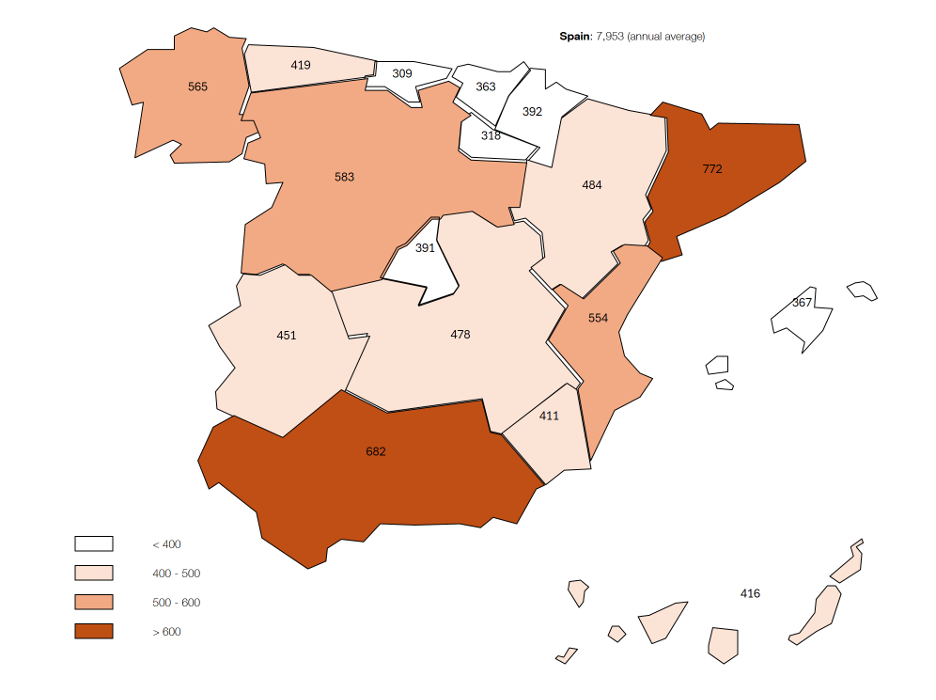
In Spain, regulation varies both between sectors and across different regions, whose production of rules is shown in the map (Chart 2). This is evident not only in the volume of regulation, but also in its fragmentation and its specific features, as we discuss here. As a result, firms face significant disparity in legal and administrative requirements depending on where they operate and in which sector.
Chart 2
NUMBER OF SECTORAL REGULATIONS BY SECTOR AND REGION. ANNUAL AVERAGE FOR THE PERIOD 1995-2020
SOURCE: Mora, Quintana, Soler and Spruk (2023)
The economic cost of the regulatory tangle
Increased regulation can have negative effects on economic activity, especially on smaller firms, as we showed in a recent study. A higher volume of rules leads to a reduction in the entry of new firms and less job creation. In some sectors, such as the industrial sector, there is a clear negative relationship between regulatory density and business dynamism.
DID YOU KNOW ...?
- Small businesses are the most sensitive to increased regulation, as they have less capacity to absorb compliance costs.
- Thus, in Spain a 10% increase in the volume of regulation leads to a 0.5% drop in employment at companies with fewer than 10 workers.
In addition, the coexistence of different rules in each region – so-called regulatory fragmentation – can increase compliance costs for businesses, hinder territorial expansion and reduce the efficiency of the internal market. This can affect SMEs in particular, as they often lack legal advisory services that would help them operate in several regions at the same time.
When national and regional regulations are aligned, firms tend to innovate more. There is a need to coordinate, assess and simplify regulations
Innovation can also suffer
Regulatory complexity also limits firms' ability to innovate. While certain regulations – such as environmental or green regulations – may, when well designed, incentivise the development of new technologies, excessive or poorly coordinated regulation between administrations can give rise to uncertainty, deter investment and reduce the scope for entrepreneurial activity.
In the field of green regulation, for example, we have observed that the effects on innovation depend to a large extent on the consistency between national and regional regulations. When rules are aligned, they can spur the adoption of cleaner technologies, but when they are inconsistent or contradictory, the effects can be counterproductive.
Moving towards better institutional quality
Regulation is necessary and should facilitate the orderly functioning of economic activity. The challenge, therefore, is not necessarily to have less regulation, but to improve its design, clarity and coordination. Effective regulatory policy requires mechanisms for assessment, streamlining and coordination across administrations. Crucially, regulatory impact analyses should be strengthened and unnecessary overlaps between the different tiers of government avoided.
Reducing the regulatory tangle would not only lower costs for existing firms, but also encourage the entry of new businesses and entrepreneurs and the growth of innovative projects. Ultimately, moving towards a more efficient regulatory environment can contribute to improving productivity, competitiveness and overall economic well-being.

DISCLAIMER: The views expressed in this blog post are those of the author(s) and do not necessarily coincide with those of the Banco de España or the Eurosystem.