
The Banco de España’s Historical Archive: a chronicle of our past
The Banco de España’s Historical Archive is one of the best-preserved bank archives in the world. It safeguards millions of documents dating back to 1782 and oversees our remarkable collection of banknotes and coins. It is an indispensable source of information about Spain’s modern history and is increasingly accessible to the public.
If you've ever wondered about the secrets of Spain's economic and financial past, the Banco de España’s Historical Archive may have some answers for you. Its 15 km of shelves are filled with documents dating back to 1782 detailing every aspect of the Bank’s functions and activities from its inception to the present day. But beyond the Bank’s own history, the Archive also chronicles Spain’s monetary, financial, social and business legacy. What are the Archive’s main treasures? What other fascinating items does it hold? How can researchers and the general public access them?
A central bank with a rich history
In Spain, the central bank began its journey as the Banco Nacional de San Carlos in 1782. It was founded with nearly 5,000 shareholders, including King Charles III of Spain, from whom it took its name, and the painter Goya, whose share certificate can be seen in Image 1. The shareholders would gather once a year for the General Meeting where they would receive updates on the institution’s progress and the dividends they were to receive.
Image 1
GOYA, SHAREHOLDER OF THE BANCO NACIONAL DE SAN CARLOS
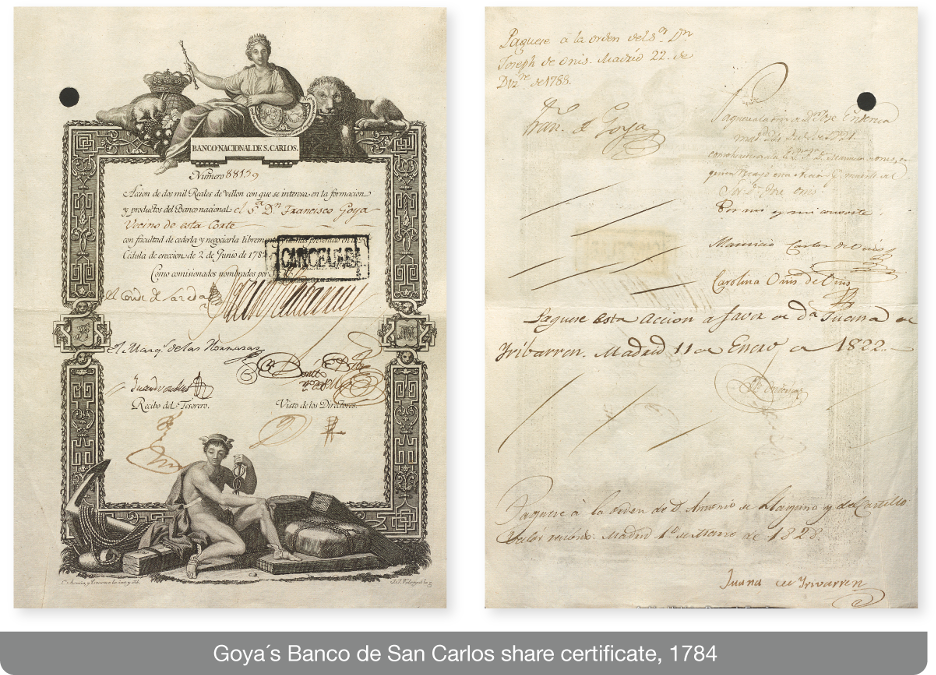
SOURCE: The Banco de España’s Historical Archive.
NOTE: Share No 88,159 of the Banco de San Carlos in the name of Francisco de Goya, 1784. The front specifies the painter’s ownership and the reverse shows his well-known signature.
In 1829 it was renamed the Banco Español de San Fernando before adopting its current name, the Banco de España, in 1856. The Bank remained a private company until it was nationalised in 1962. Prior to this, it served a range of customers who opened accounts, made deposits, took out loans or rented safe deposit boxes. Among these customers was the renowned writer Benito Pérez Galdós.
The Archive holds a vast collection of documents on shareholders, customers and financial institutions – an indispensable resource for studying Spain’s economic and social history
The Archive offers an extensive and detailed collection of documents on shareholders and customers. This wealth of information enables a wide range of economic, social, regional and even gender-based studies to be conducted at both micro- (using microdata) and macroeconomic level.
Banknotes and coins
The Archive houses examples of all Spanish banknotes since 1783, alongside a significant collection of coins, providing an excellent overview of 24 centuries of minting.
Among its treasures are the very first banknotes in Spanish history, issued by the Banco de San Carlos in 1783 (Image 2). The Banco de España produced very beautiful banknotes and the Archive chronicles developments in currency design, production, technology, security measures, counterfeiting and circulation. These aspects are crucial for studying the history of banknotes, while the latest developments in banknote technology were the subject of a recent blog post.
Image 2
THE FIRST BANKNOTE (1783)
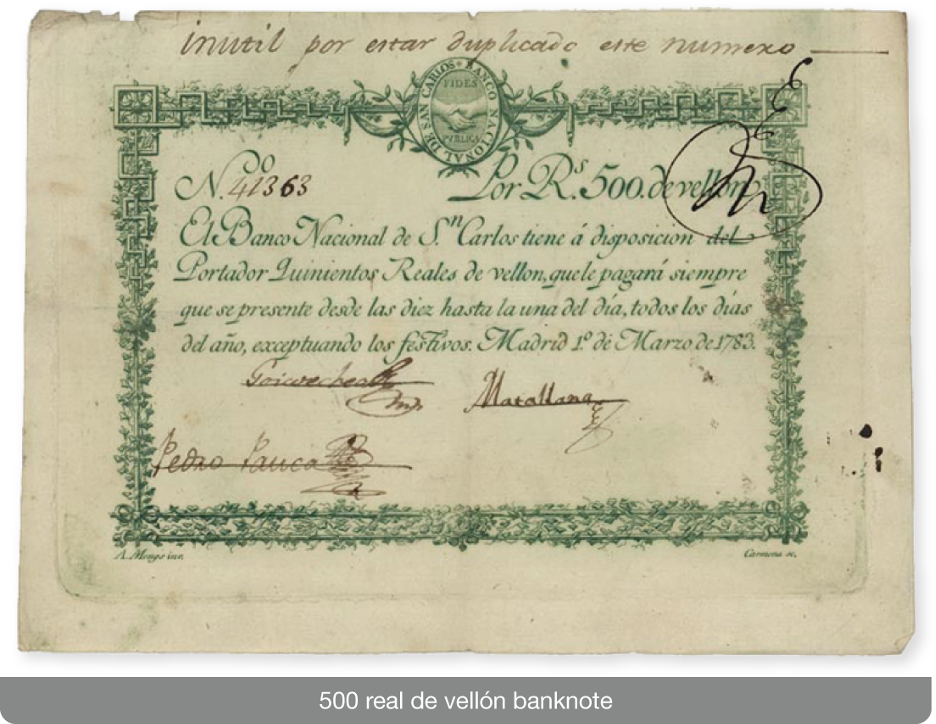
SOURCE: The Banco de España’s Historical Archive.
NOTE: A banknote from the very first series of banknotes in Spanish history, issued on 1 March 1873. 7 of the 9 securities issued have been conserved. The real de vellón was a unit of currency in the 19th century.
The series of Spanish eight escudo coins (“onzas”) is particularly noteworthy in the coin collection (Image 3).
Image 3 (interactive)
SELECTED HIGHLIGHTS IN THE COIN COLLECTION
SOURCE: The Banco de España’s Historical Archive.
DID YOU KNOW ...?
- Banknotes often depicted significant people in Spain’s history, including those mentioned above.
- Goya was the face of the first banknote issued by the Banco de España in 1874, with a value of 500 pesetas ... which was a lot back then! He appeared four more times: in 1886 (as shown in the picture), 1889, 1946 and finally 1948.
- Older readers might recall the first 5000 pesetas note, issued in 1976, featuring the portrait of King Charles III, and the 1000 pesetas note from 1979, which bore the image of Pérez Galdós.
- With the advent of the euro, portraits vanished from our banknotes. However, they might make a comeback. The European Central Bank has selected portraits of European figures for future euro banknotes, including Miguel de Cervantes.
Image 4 (interactive)
ILLUSTRIOUS SPANIARDS ON BANCO DE ESPAÑA BANKNOTES
SOURCE: The Banco de España’s Historical Archive.
NOTES:
-The Goya banknote (1886) is based on the portrait by Vicente López, created in the Banco de España’s workshops.
-The 5000 peseta banknote showing Charles III of Spain is the first of its denomination. It was printed by the Spanish Royal Mint.
-The banknote showing Galdós (1979) introduced a modernised design. The artist José María Cruz Novillos was involved in its creation. It was printed by the Spanish Royal Mint.
Branches
The Archive also provides valuable insights into the economics of the 76 cities in which branches were established between 1858 and 1874, shedding light on the commercial activities, business leaders and urban transformations in each. Notably, the Archive includes hundreds of plans and photographs of the buildings that were constructed for the branches, all meticulously catalogued.
Financing the state
Historically, central banks have played a key role in supporting state expenditure. Among the Archive’s most significant records are documents illustrating the Banco de España’s involvement in financing the Spanish State. Indeed, the Banco de San Carlos was founded to help the Spanish Crown meet the extraordinary financial demands stemming from the United States’ War of Independence. The institution’s subsequent enduring links to State finances are evidenced in the Archive, with all kinds of documentation related to funding agreements, debt certificates and advances.
Private banking and external trade
From the outset the Banco de España has maintained close ties with other banks and financial corporations. Following nationalisation in 1962, it assumed responsibility for supervising Spain’s banking sector. As a result, the Archive has amassed a vast body of documentation that is indispensable for studying the history of banking in Spain. It also holds valuable records from the Spanish Foreign Exchange Institute (the body tasked with foreign exchange controls), shedding light on external trade during the Franco era.
An archive at the public’s service
To delve into the Banco de España’s Historical Archive is to discover an extraordinary wealth of historical documentation. And thanks to the Archive’s increasing openness – both to researchers and the general public – this heritage has never been more accessible.
In keeping with the times, much of the collection has been digitised and made freely available to the public through the Banco de España’s Institutional Repository. Some of the collections have been published as catalogues.
We are committed to making the Archive’s heritage more widely available and fostering ever greater openness and accessibility for both researchers and the general public
The Archive also serves as a key resource for historical and economic research in Spain. Since it was opened to the public in 1982, the Archive has been consulted by hundreds of researchers and contributed to major academic studies, including this work by Pedro Tedde de Lorca and this one by Pablo Martín-Aceña, historians closely affiliated with the Banco de España. Among the most common areas of research are state financing, banknote issuance, monetary policy, economic and financial consultancy and business and political history. Researchers also frequently search for information on the Spanish civil war, international relations, art history, family history and genealogy, and women’s history.
DID YOU KNOW ...?
Any member of the public or researcher can consult the Banco de España’s Historical Archive by simply filling out this contact form and describing their research topic.
As well as providing free access to our publications and the repository, we also organise exhibitions. In 2024 we hosted “Photographic Archive. Banco de España. From Albumen to Pixel”, the first ever public exhibition of our historical photograph collection, which attracted more than 20,000 visitors. We also open our doors during International Archives Week and Open Administration Week. This year we hosted the exhibition “Celebrities in the Historical Archive” in the Historical Archive room itself.
All this reflects our commitment to sharing the Archive’s rich heritage with the public, in line with the principles of openness and transparency enshrined in the Strategic Plan 2030.

DISCLAIMER: The views expressed in this blog post are those of the author(s) and do not necessarily coincide with those of the Banco de España or the Eurosystem.