
How to strengthen trust in central banks: transparency and accountability
Central banks make decisions that have a significant economic and social impact. As independent institutions, transparency and accountability are essential to upholding their credibility and legitimacy. A comparative study of 35 institutions examines how these authorities are adopting a more strategic and participatory approach aimed at strengthening public trust.
15/09/2026
If central banks are to perform their role effectively, independence is crucial. This is particularly true when it comes to keeping inflation under control and supervising financial institutions. However, such autonomy must go hand in hand with sound transparency and accountability mechanisms, ensuring that decisions are clearly explained and open to public scrutiny. The more freedom of action an institution enjoys, the greater the need to explain its decisions and make them understandable. What do transparency and accountability mean for central banks and financial supervisors? And how are these concepts evolving? A recent study led by the Banco de España offers some answers. Here’s what we found.
Independence, transparency and accountability are three inseparable principles (Figure 1). Independence provides central banks and supervisory authorities with the autonomy they need to act in the public interest, free from external pressures. Transparency helps market participants and the wider public understand the decisions they make, while accountability ensures the rationale behind those decisions are explained and justified, meeting society’s expectations and strengthening central banks’ legitimacy in the eyes of the public.
Figure 1
THE RELATIONSHIP BETWEEN INDEPENDENCE, TRANSPARENCY AND ACCOUNTABILITY IN THE BANCO DE ESPAÑA
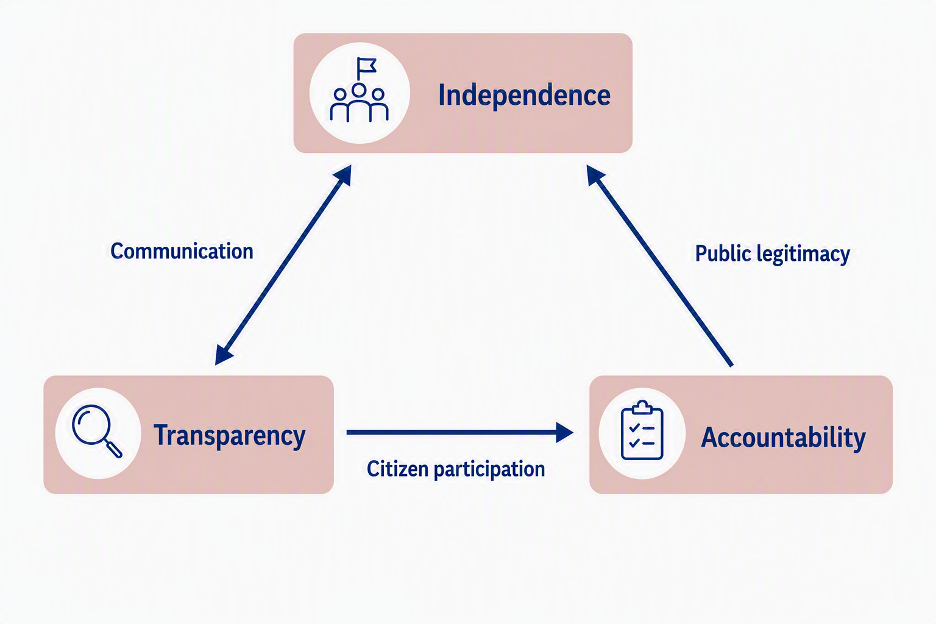
SOURCE: Devised by authors based on Amtenbrink (2008) .
.
A recent study led by the Banco de España, entitled “Transparency and accountability as drivers of cultural change. A comparative analysis of central banks and national competent authorities”, takes a closer look at these mechanisms, highlighting key trends and the challenges institutions must address to strengthen their legitimacy and uphold public trust.
DID YOU KNOW ...?
- 35 institutions took part in the study: 28 central banks and seven supervisory authorities.
- 30 of the institutions were from European Union countries, including 25 from the euro area. The remaining five were the central banks of Canada, Chile, Colombia, Moldova and the United Kingdom.
- The study drew on a 46-question survey covering transparency, communication, access to information, public participation and accountability.
- The paper proposes an index to assess the maturity of these practices and support their deeper integration into institutional governance.
When it comes to building trust in an institution, transparency and accountability go hand in hand. Together, they help institutions to explain their decisions clearly, make them more understandable and reinforce their credibility over the long term (Figure 2).
Figure 2
KEY ELEMENTS OF TRANSPARENCY AND ACCOUNTABILITY
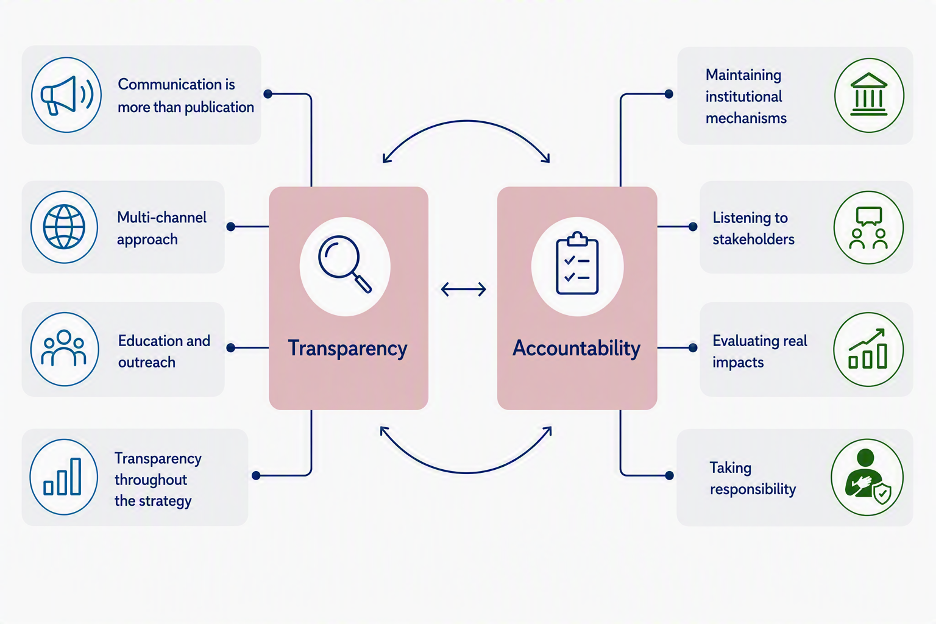
SOURCE: Devised by authors.
From information disclosure to genuine transparency
The concept of transparency is changing. Traditionally, it was largely associated with disclosing information and meeting regulatory obligations. Today, however, as the study shows, the leading institutions recognise that transparency cannot be measured solely by the quantity of information available.
The challenge is to ensure that the information is accessible, understandable and useful. We live in an age of information overload, a proliferation of communication channels and an increasingly complex economic and financial landscape. Against this backdrop, transparency can only be effective if institutions explain and contextualise information in ways that different audiences can understand.
The study suggests that this shift is already taking place, with institutions making increasing use of digital tools, social media, outreach initiatives and educational programmes.
DID YOU KNOW ...?
- 29 of the 30 European institutions voluntarily publish more information than the rules require. This shows that central banks now see transparency as a way to explain their work clearly and engage with the public.
- The Banco de España is also committed to transparency as a strategic priority. This has led to a shift in the way we communicate, as shown in our latest Institutional Report and explained in this blog post.
Effective transparency is not just about releasing more information. It means providing high-quality information that is accessible and easy to understand to make the institution closer to the public
Effective transparency is not just about releasing more information. It means providing high-quality information that is accessible and easy to understand and delivering it through the right channels. This shifts the focus away from simply making data available and towards ensuring that the information provided is useful and meaningful, helping the public understand the institution’s objectives, functions and decisions.
Accountability is about more than providing information
If transparency helps people know what an institution does, accountability gives them the tools to understand its actions and, where appropriate, hold it responsible for them. For this to happen, institutions must explain why certain decisions are made, set out the underlying rationale and provide the information needed to evaluate the outcome.
Accountability means explaining decisions, justifying their reasons and providing evidence that makes it possible to judge the institution’s actions and bolster public trust
Traditional accountability channels, such as appearances before parliament, regular reports, audits and external evaluations, remain essential for explaining and justifying institutional action.
However, the study shows that the idea of accountability is evolving. As with transparency, more and more institutions believe that accountability should not be limited to mere compliance. Instead, it should be seen as an ongoing process of explanation and openness to dialogue with stakeholders.
In practice, accountability does not mean simply following established formalities. It also means clearly setting out objectives, explaining the reasons behind decisions and providing evidence that allows others to judge whether the institution’s actions are appropriate and, where relevant, hold it accountable.
That is why our study stresses the importance of assessing these mechanisms in a way that goes beyond a mere box-ticking exercise. The key question is whether they really help make the institution’s actions easier to understand and open them up to public scrutiny. If they do, they strengthen trust and public legitimacy. Figure 3 outlines the main aspects of this model.
Figure 3
ACCOUNTABILITY IN A CENTRAL BANK
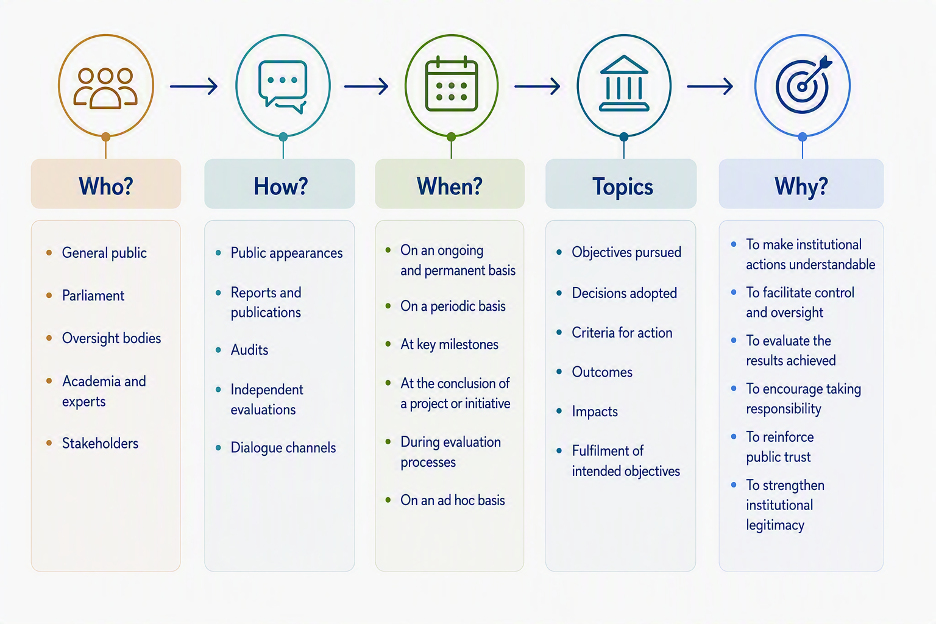
SOURCE: Devised by authors.
The challenges of the digital age
Digitalisation is rewriting the relationship between institutions and society. As the study shows, this new landscape comes with a number of challenges, summarised in Figure 4.
Figure 4
TRANSPARENCY AND ACCOUNTABILITY CHALLENGES IN THE DIGITAL ERA
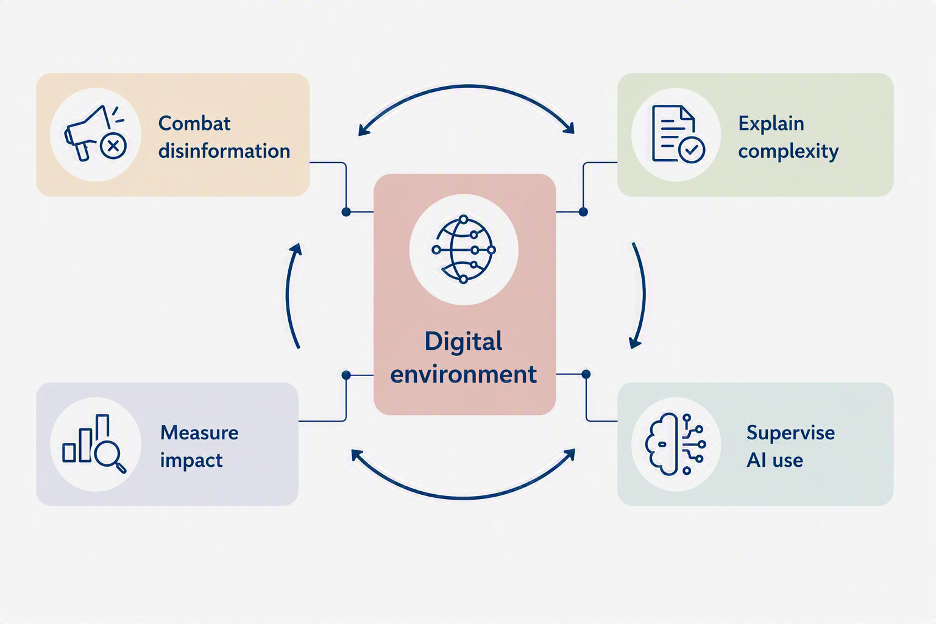
SOURCE: Devised by authors.
One of the most important is combating disinformation. The speed at which information circulates can facilitate fraud and fuel the spread of misleading or manipulative content, which may affect public perception. In this context too, transparency and accountability are tools for preserving credibility and trust.
Artificial intelligence (AI) is another area that deserves attention. Although its use remains uneven, institutions agree on the importance of ensuring oversight, traceability and responsibility when these technologies are involved in making important decisions and delivering services.
A question of trust
The study’s conclusions paint a clear picture. Independence remains essential if central banks are to carry out their work effectively. But public trust does not follow automatically from independence.
In a context shaped by digitalisation, economic complexity and higher public expectations, institutional legitimacy increasingly depends on the ability to explain decisions, justify the rationale behind them, make them easier to understand and maintain close engagement with the public.
When the three pillars of independence, transparency and accountability reinforce one another, they support the institution’s integrity, bolster public trust and help deliver better outcomes for society.