
25 years of the Financial Stability Review: charting a financial system in transformation
We launched the Financial Stability Review in 2001. 25 years and 50 issues later, it has covered the crises, tensions and challenges that have shaped financial system developments over the past quarter of a century and how regulation and financial supervision have evolved in response.
One of the Banco de España’s key tasks under its Law of Autonomy is to promote the smooth functioning and stability of Spain’s financial system. To do so, we have a range of analytical, rule-making, compliance and sanctioning powers in the fields of regulation , macroprudential policy, banking supervision and the resolution of credit institutions. There is a clear rationale behind this goal of stability, an objective that we share with other Spanish and European authorities.
A stable financial system matters because it can withstand adverse economic or financial shocks without significantly impairing its core function: financial intermediation, in other words, channelling savings into investment and financing for the economy. If that role is disrupted, shocks are amplified and ultimately hit the wider economy harder.
When did financial stability shift from the margins to become a central subject of study and strategic analysis for central banks and other authorities? Which Banco de España publications trace that analytical work? This blogpost turns the spotlight on the Financial Stability Review and what it tells us about the major crises and innovations that have affected the stability of the Spanish financial system over the last 25 years, as well as the challenges it may face in the future.
Financial stability under the spotlight
The 1990s and the early 2000s saw episodes of crisis and macro-financial instability in different parts of the world (such as the 1997 Asian financial crisis and the bursting of the dot-com bubble in 2000-01).These episodes revealed the costs of bouts of instability and highlighted the need for closer cooperation between institutions – such as finance ministries, central banks and supervisory authorities – and for international coordination.
Against this backdrop, central banks began to devote ever more resources to analysing financial stability and to setting out their findings and proposals in regular publications. The Banco de España was part of this trend. In 2000 we created a Financial Stability Division and, just one year later, published the first issue of our Financial Stability Review.
The Financial Stability Review is a key vehicle for the Banco de España to communicate with the public about financial stability, but it is not the only one. The Financial Stability Report also plays a role in this area.
- Using the latest information, the Financial Stability Report analyses financial system developments, with a particular focus on the banking sector. It focuses on the main risks and vulnerabilities identified and reflects the Banco de España’s institutional position on financial stability.
- The Financial Stability Review features articles on selected topics written in a technical but accessible style and authored by Banco de España or external staff and published under their own names. They are subject to independent review and do not necessarily reflect institutional positions. The Financial Stability Review is governed by an Editorial Board, which I have the honour of chairing, made up of representatives from both the Banco de España and academia.
This distinction has enabled the Financial Stability Report to serve as a regular “snapshot” of the financial system, while the Financial Stability Review is geared more towards academic analysis, but also aims to reach a wider audience.
Both financial stability publications complement one another. The Financial Stability Report provides a regular snapshot of the financial system and the risks to which it is exposed. The Financial Stability Review is a space for academic analysis and dissemination.
DID YOU KNOW ...?
In addition to the Financial Stability Review, various Banco de España publications discuss matters related to recent developments, papers and measures in the field of financial stability, microprudential supervision and macroprudential policy, namely:
- the Financial Stability Report (half-yearly);
- the Supervision Report (annual);
- the Institutional Report (annual);
- the Working Papers and Occasional Papers series, which cover a wide range of topics, including financial stability.
The Banco de España’s Financial Stability Review in numbers
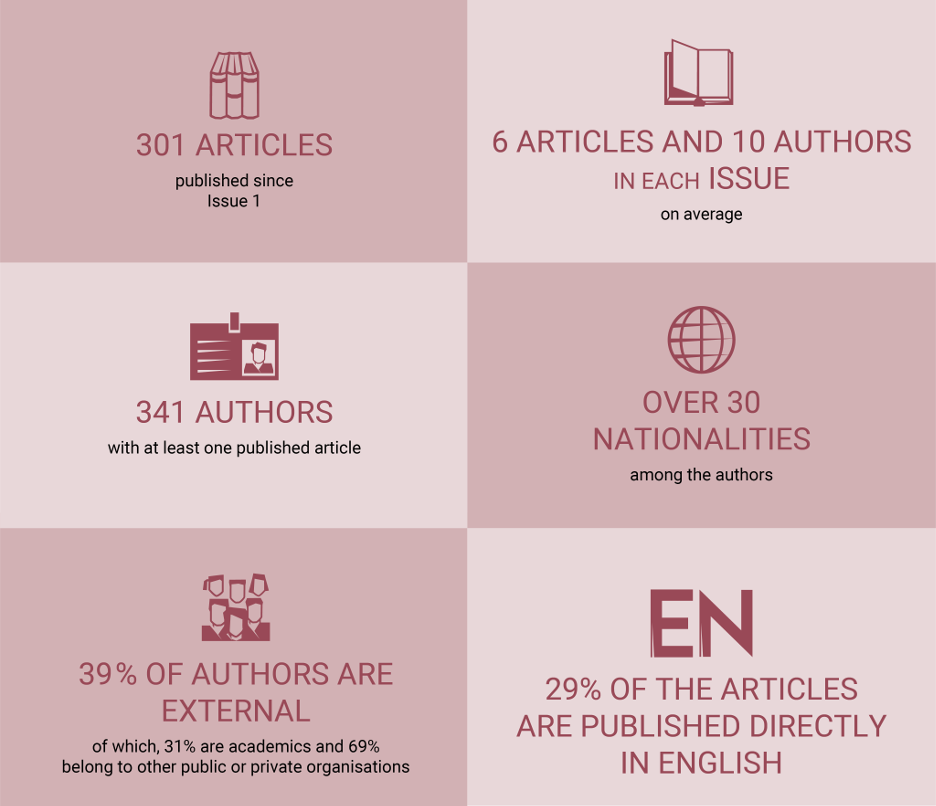
The Financial Stability Review was designed to be a long-running publication, aiming to combine quality, pluralism and practical relevance for a broad professional and academic community. Today, this commitment is reflected in its strong track record (Figure 1):
Figure 1
25 YEARS OF THE REVIEW, IN NUMBERS
SOURCE: Devised by authors.
A quarter of a century later, the Financial Stability Review has published over 300 articles by close to 340 authors. Averaging six articles per issue, the review has built a broad and international contributor base: 39% of contributions are from external authors, close to one-third of articles have been published directly in English and contributors hail from over 30 different countries.
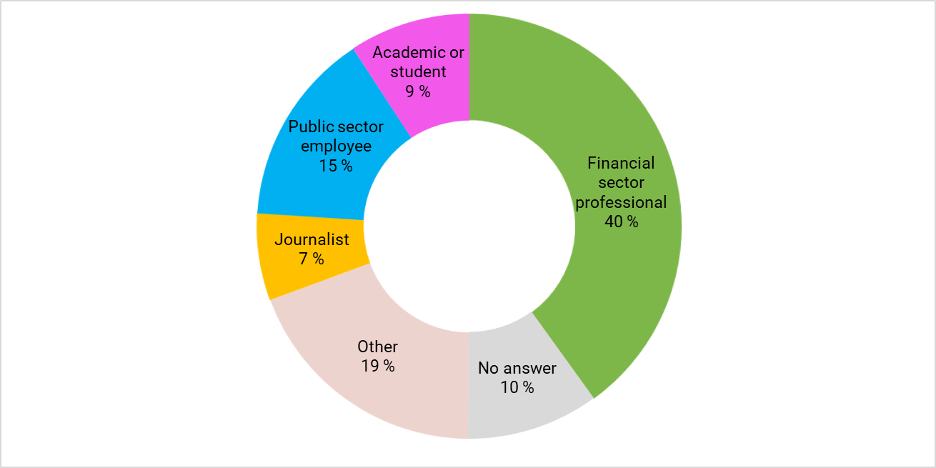
Who are our readers? We are boosting our presence on social media (X – formerly Twitter – and LinkedIn). A recent survey points to the diversity of our readership: 40% are financial sector professionals, 15% are public sector employees and close to one in ten are academics or students (Chart 1).
Chart 1
FINANCIAL STABILITY REVIEW READERS IN 2025
Source: Devised by authors.
DID YOU KNOW ...?
You can download Financial Stability Review articles for free on the Banco de España website. You’ll find:
- details on regulatory and supervisory developments in Europe and internationally;
- information in Spanish about regulatory and supervisory matters that are otherwise only available from English-language sources;
- analysis of risks to financial stability that are the focus of – and a source of concern for – Banco de España experts;
- a platform for collaboration and participation for non-Banco de España experts.
An ever-evolving thematic agenda
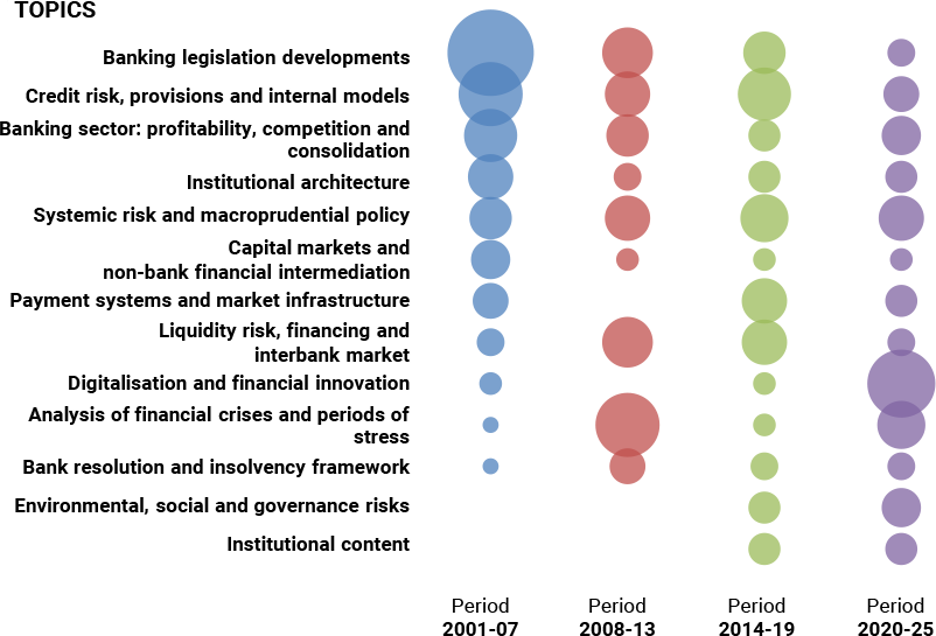
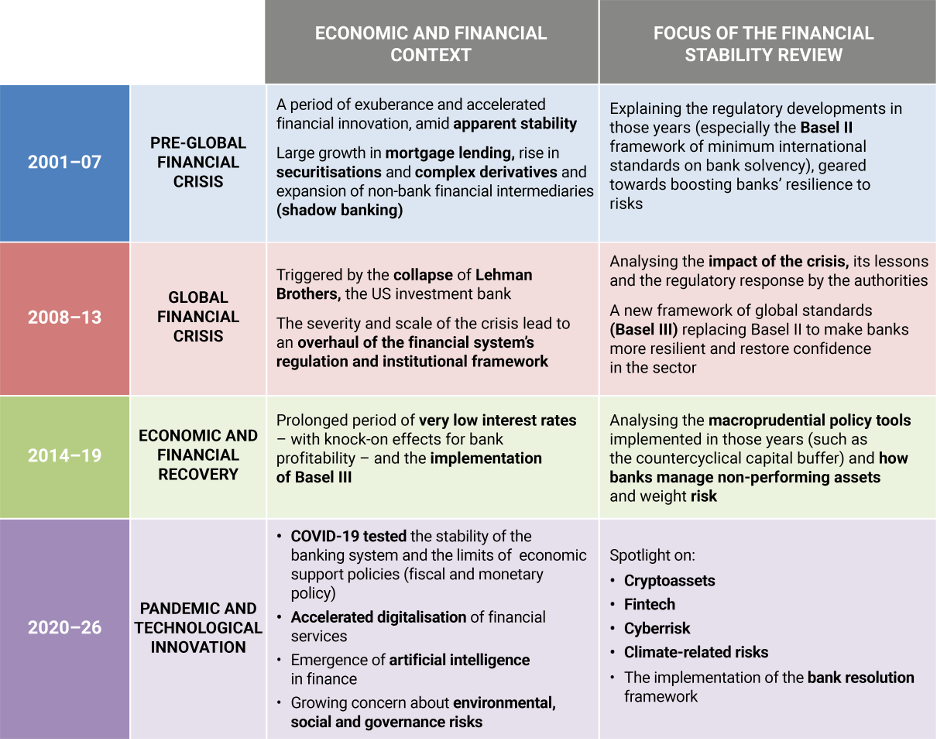
Looking back over the past 25 years of the Financial Stability Review is to trace the transformation of the financial system in the first quarter of the twenty-first century. Up to four distinct periods can be identified, during which different topics – some recurring, others emerging in each phase – have come to the fore. This is reflected in the number of articles published on each topic (Figure 2):
Figure 2
TOPICS OF THE ARTICLES PUBLISHED IN THE FINANCIAL STABILITY REVIEW, BY CATEGORY (2001-2025)
Articles by category in each period
Source: Banco de España.
NOTE: The size of each bubble is directly proportional to the number of articles published on each topic. Each article has been assigned to a single category, although in various cases they could fall under more than one.
Comparing the shift in the topics addressed in the Financial Stability Review with sectoral milestones shows that over the years the environment has gradually shaped the review’s focus (Figure 3):
Figure 3
HISTORICAL OVERVIEW: THE ENVIRONMENT AND THE FINANCIAL STABILITY REVIEW
Source: Devised by authors.
NOTES: Basel II and Basel III
Looking ahead
Financial stability will undoubtedly continue to face new challenges. Today’s landscape brings together emerging topics – such as the fresh boom in non-bank financial intermediation and the challenges posed by artificial intelligence in finance – with more traditional issues, including the analysis of banking sector solvency, regulation and supervision, and crisis management.
The risks to financial stability are ever-changing, ensuring that the Financial Stability Review will remain highly relevant for many years to come. With that in mind, our original goal from 2001 remains the same: to provide a platform for different disciplines and approaches, where rigorous analysis helps us understand a constantly evolving financial system and the factors that keep it stable.