
How the weather affects your grocery bill: the case of El Niño and La Niña
What can Pacific Ocean temperatures possibly have to do with your grocery bill? Much more than you might expect. Extreme weather events, such as El Niño and La Niña, in distant parts of the world affect the prices of what we eat and drink every day, like bread and coffee. And now another El Niño is brewing.
10/06/2026
El Niño and La Niña happen thousands of miles away, but their effects eventually reach your wallet. The weather disruptions they cause influence the production of food commodities in the affected countries, some of which are major global suppliers. When production falls, prices rise; when production is strong, prices drop. Through international trade, these changes eventually have an impact on what we pay in Europe for everyday products such as bread, meat and coffee. The surge in inflation after the pandemic has renewed concerns about the impact on prices of such phenomena and of climate change more broadly. Find out how inflationary waves can start in the Pacific Ocean, just as another El Niño is strengthening .
.
DID YOU KNOW ...?
- El Niño and La Niña are two extreme phases of a climate pattern known as El Niño - Southern Oscillation (ENSO).
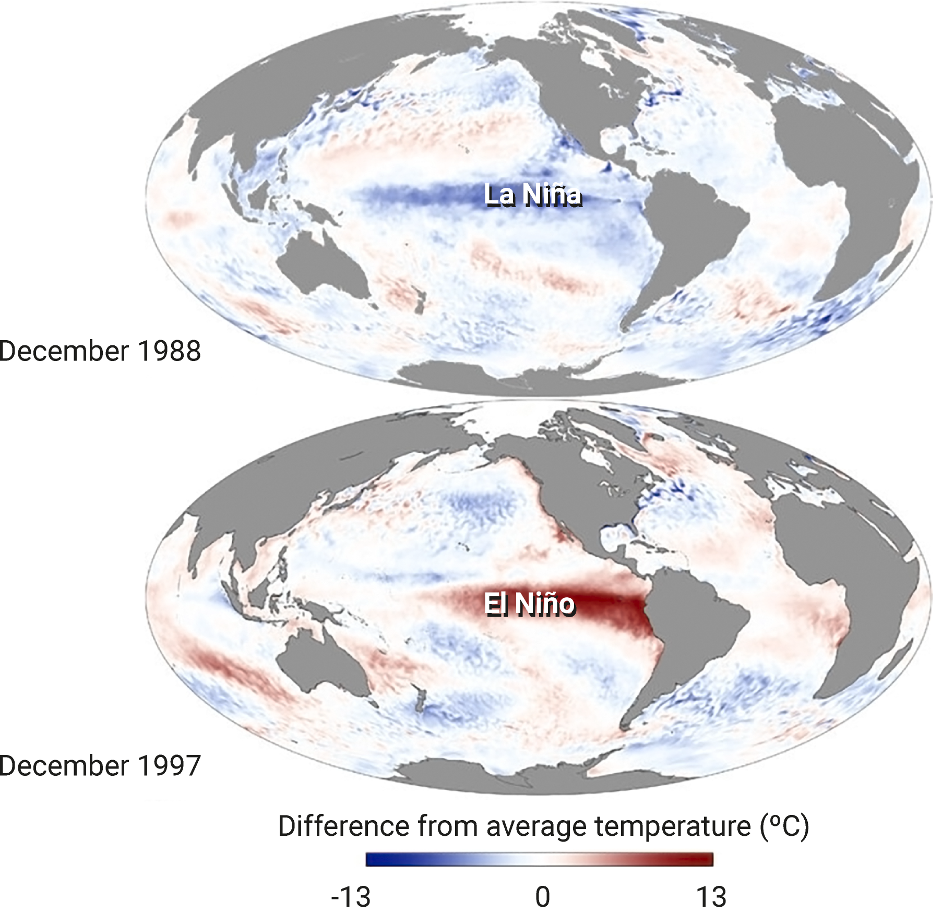
- During this cycle, Pacific Ocean surface temperatures fluctuate, as shown in Chart 1:
- El Niño occurs when ocean temperatures are warmer than usual;
- La Niña when they are cooler;
- normal temperatures are defined as the neutral phase.
- These shifts in ocean temperatures can alter rainfall patterns, sea currents, winds and temperatures, even thousands of miles away.
- In particular, they affect countries in America, Asia, Oceania and Africa. For example, southern and southeastern Brazil:
- El Niño brings wetter and milder conditions. However, in the Amazon basin it can intensify droughts and extreme weather events such as heatwaves and wildfires.
- La Niña generally reverses these weather patterns, producing broadly opposite effects.
- El Niño refers to the Christ Child and got its name from Peruvian and Ecuadorian fishermen who noticed that ocean temperatures were unusually warm around Christmas. The opposite phase, marked by cooler ocean temperatures, was later named La Niña.
Chart 1
THE IMPACT OF EL NIÑO AND LA NIÑA ON SEA TEMPERATURES
SOURCE:Climate.gov
NOTE: Maps of sea surface temperature anomaly in the Pacific Ocean during a strong La Niña (top, December 1988) and El Niño (bottom, December 1997). Maps based on data provided by NOAA View
How do El Niño and La Niña affect food prices?
During an El Niño episode, more abundant rainfall boosts wheat production in parts of South America, for example, in Argentina. In Australia, however, the same phenomenon can bring drought conditions that reduce the country’s wheat harvest. On balance, the positive effect tends to prevail, increasing global wheat supply and pushing international wheat prices down. The drop in wheat prices is felt first by flour mills, which buy the grain as a raw material, and then by bakeries, which face lower flour costs, eventually leading to cheaper bread.
Figure 1
THE IMPACT OF CLIMATE CHANGE ON OUR WALLETS
SOURCE: Devised by authors
And what about meat? El Niño episodes usually boost soybean harvests in Brazil, Spain’s main source of imported soybeans. We have also seen that these episodes can bring down the price of cereals, an essential source of livestock feed. As animal feed is a major expense for meat producers, meat tends to become cheaper. This effect is especially pronounced in short-cycle meat production, such as poultry and pork, where feed represents a substantial portion of the total cost. So, when El Niño lowers cereal and soybean prices, meat often becomes cheaper too.
What impact does La Niña have? Here, the pattern is reversed: wheat-growing conditions improve in Australia, while parts of South America may experience droughts or adverse weather patterns that hamper production. This may reduce global wheat production, leading to higher international cereal prices. La Niña therefore tends to drive up cereal and feed prices, eventually making flour, bread and meat more expensive.
An example of a product that has become more expensive because of El Niño is cocoa. In recent years, Ivory Coast and Ghana, which together account for around 60% of world cocoa production, have suffered from extreme rainfall followed by droughts associated with El Niño. Along with other factors, these conditions have led to plant disease and smaller harvests, pushing prices to record levels, with a notable impact on chocolate.
The impact of El Niño on coffee depends on the variety and where it is grown. Recent studies show El Niño pushes down the price of coffee beans in Europe, although its impact is not statistically significant.
In Europe, El Niño tends to make food cheaper, while La Niña tends to make it more expensive, contrary to past experience.
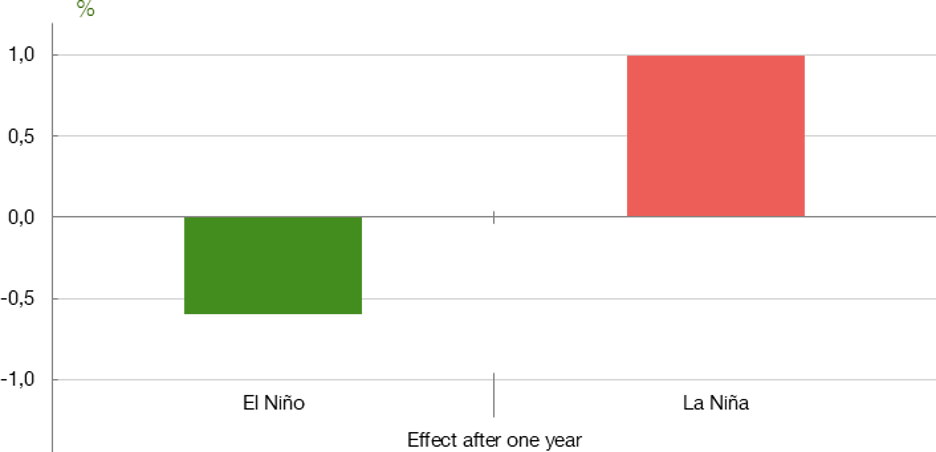
As Chart 2 illustrates, in the euro area we find that El Niño tends to make the food basket around 0.6%-0.7% cheaper after 12 months, whereas La Niña makes it 1.0%-1.1% more expensive.
Chart 2
TO WHAT EXTENT, AND HOW, DO EL NIÑO AND LA NIÑA AFFECT FOOD PRICES IN THE EURO AREA?
SOURCE: Borrallo, A., L. Cuadro-Sáez, C. Ghirelli and J.J Pérez (2026).
NOTE: The bars show the extent to which food basket prices have changed in the euro area as a whole, one year after the El Niño or La Niña episode has been classified as severe.
The impact of El Niño and La Niña on food prices has changed over time
In the 1970s and 1980s, El Niño would trigger spikes in international food commodity prices, with particularly severe episodes leading to rises of well above 10%. In this century, however, its impact has diminished and even reversed, as we have seen with wheat and related products.
This shift can be explained by several factors: longer intervals between extreme episodes, the adoption of measures to safeguard production and policies that have boosted Europe's food imports from countries less exposed to these episodes.
DID YOU KNOW ...?
- Measures to safeguard production include climate monitoring systems that help anticipate or adapt harvests, better protect livestock and make fishing ports safer, among many other initiatives.
- The Common Agricultural Policy (CAP) helps mitigate the effects of these phenomena across the European Union.
- It does this by supporting production, diversifying the sources of imports and stabilising supply, which in turn makes prices less sensitive to external climate shocks.
All this suggests that the link between climate and prices is shaped by trade, technology and policy. Although Europe is less vulnerable than it used to be, the risk has not disappeared, and climate still has an impact on the prices we pay.
Faraway phenomena with a direct impact on your grocery bill
These climate phenomena show just how deeply interconnected the global economy is: distant events can leave their mark on what we pay and, over time, on the inflation that affects us all.
El Niño and La Niña are examples of global interconnectedness: the climate changes, production and trade adjust, and prices are affected
For a central bank, understanding these connections is key to interpreting unexpected shifts in food inflation and their effect on overall inflation. Further research into these links is needed to anticipate risks and design policies that support food price stability.
As climate change is expected to heighten the impact of weather on inflation, this research is even more relevant. By understanding how the weather, production, and prices interact, we can better prepare for a future in which food security will remain a key priority.
For each of us, this knowledge helps us manage our spending by seeking alternatives that can reduce the cost of our grocery bill, and also to gain an insight into how climate change may affect our daily lives.


DISCLAIMER: The views expressed in this blog post are those of the author(s) and do not necessarily coincide with those of the Banco de España or the Eurosystem.