
Centuries of history on the page. Conserving our heritage at the Banco de España Library
Imagine you’re reading a book that dates back 500 years. How has it managed to survive wars, fires, floods and centuries of use? Largely thanks to the efforts of libraries like ours at the Banco de España.
The Banco de España Library holds a precious bibliographic heritage –old and valuable books, manuscripts and documents– that conserves our history and our identity. By preserving and, when needed, restoring the collection, we safeguard this legacy and also ensure it is accessible to present and future generations. What treasures does the Library hold? How do we care for them?
The Banco de España’s bibliographic heritage
The Special Value Collection (SVC) brings together some 17,500 works on a range of subjects dating from the 14th to the 20th century. It is separate from the Banco de España’s Historical Archive, which holds documents generated by the Bank itself. The SVC houses:
- economic and mercantile treaties such as the Instrucción de mercaderes (1544) and the Provechoso tratado de cambios (1546);
- books on arithmetic or accounting;
- decrees, regulations and similar texts;
- political treatises such as Idea de un príncipe político christiano: representada en cien empresas (1655);
- cartographic works and travel guides such as Theatro d’el Orbe de la Tierra (1612) and Spain (1876).
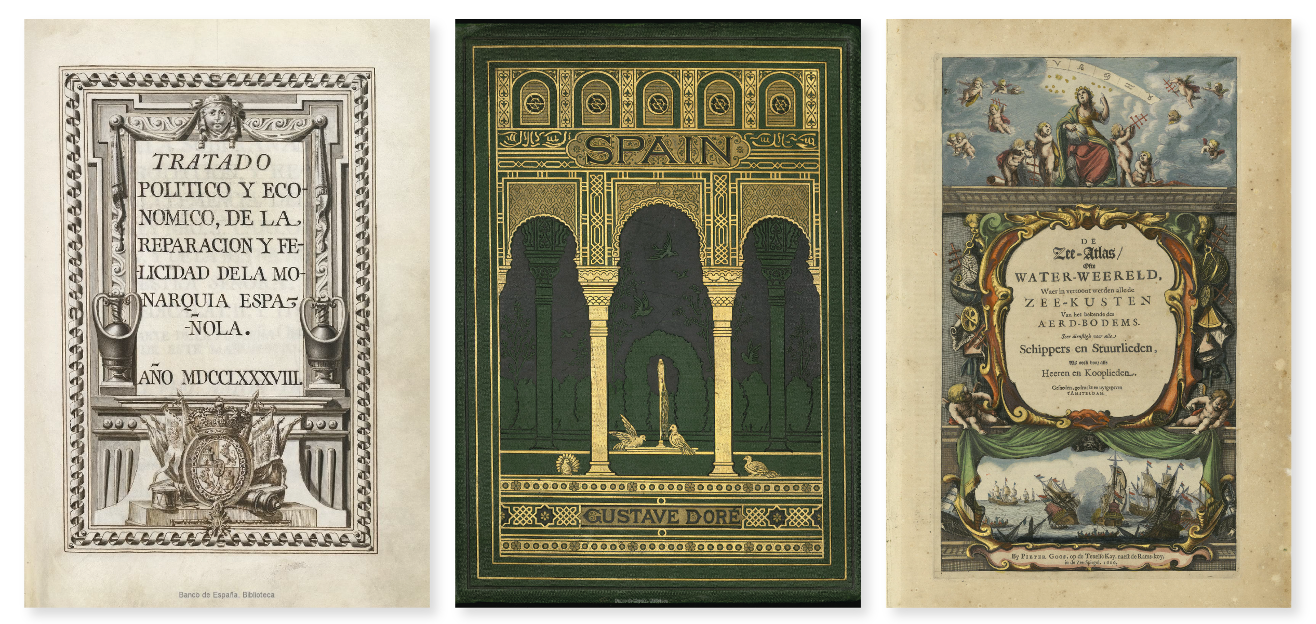
Some of these volumes are also genuine works of art (Composition 1).
Composition 1
BIBLIOGRAPHIC TREASURES, WORKS OF ART
SOURCE: Banco de España.
NOTE: Tratado político y económico, de la reparación y felicidad dela monarquía española (1788). Spain (1876), illustrated by Gustave Doré. De Zee Atlas (1666).
The SVC enjoys special protection as part of Spain’s historical heritage. As a public institution, the Banco de España –and particularly the Library– is entrusted with managing and conserving the collection, ensuring that it is held in optimal conditions and granting access to both researchers and the general public.
Why and how do we conserve our bibliographic heritage?
For centuries books have been the main means for establishing and passing on knowledge and information, but throughout history many have been lost. In recent years, the Banco de España Library has undertaken several projects devoted to conserving and making known its bibliographic heritage. Why is this important? Well, because these books and documents help us understand who we are, they allow us to learn from our past and offer inspiration for a better future.
Books help us understand who we are and where we come from, and inspire us to create a better future
Conservation entails a range of measures to preserve, or where appropriate restore, the volumes in the collection. Preservation covers all the work and procedures that seek to prevent damage. For this purpose, we have a vault where the books are kept in an optimal environment and protected with effective safety measures (Photograph 1).
Photograph 1
SPECIAL VALUE COLLECTION VAULT

SOURCE: Banco de España Library.
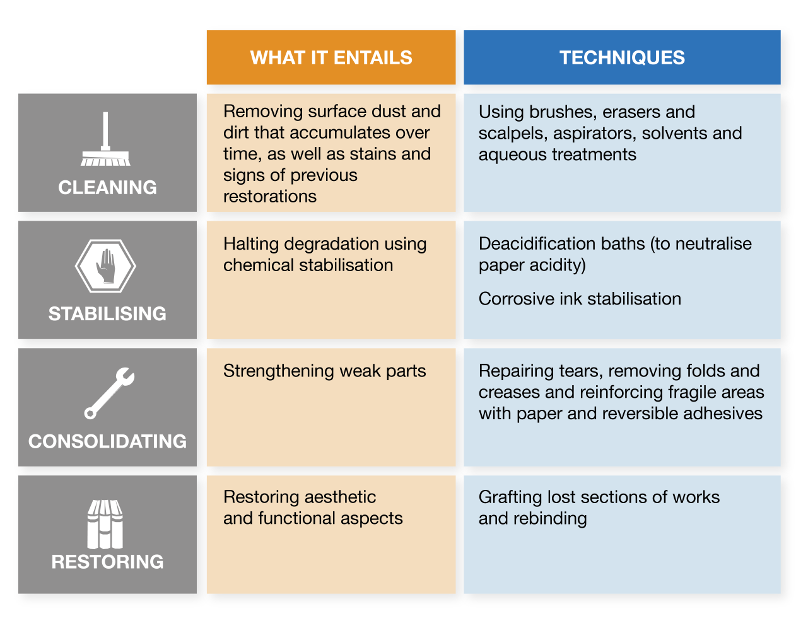
Restoration comes into play when signs of damage appear if, following an analysis, we can identify what type of intervention is appropriate (Figure 1). This work is carried out by experts in the restoration of old manuscripts, and ranges from simple cleaning to paper deacidification, the repair of water, fire or insect damage, tearing and other handling damage.
Figure 1
PROCEDURES TO CARE FOR THE SPECIAL VALUE COLLECTION
SOURCE: Devised by authors.
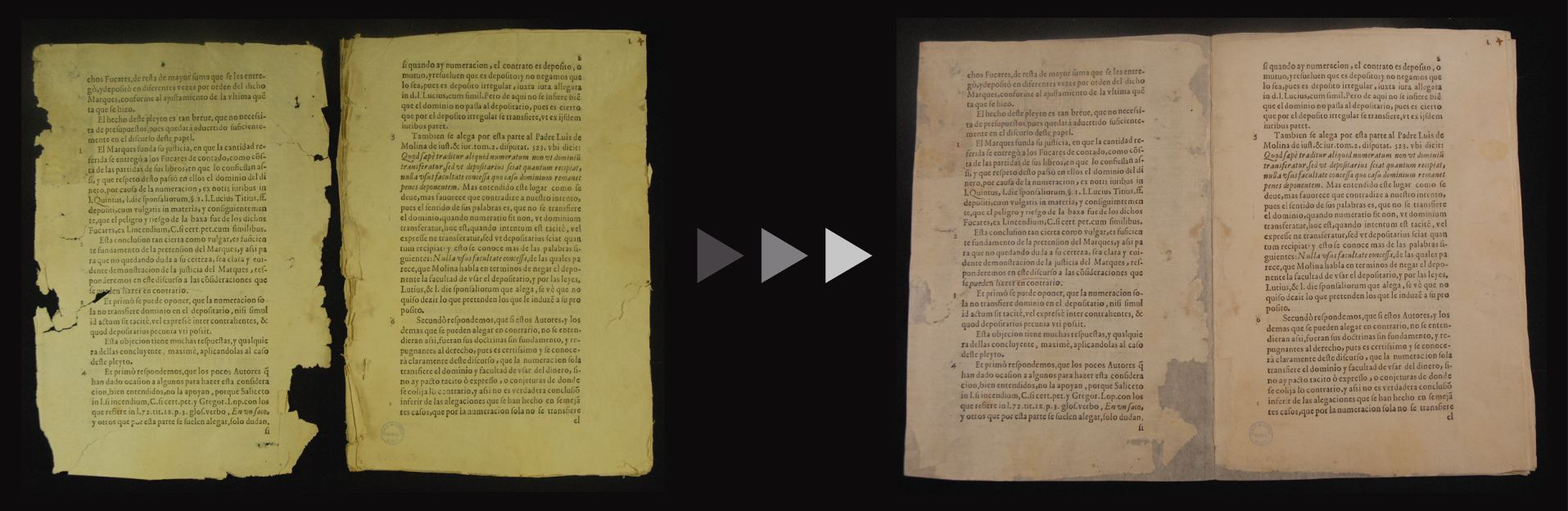
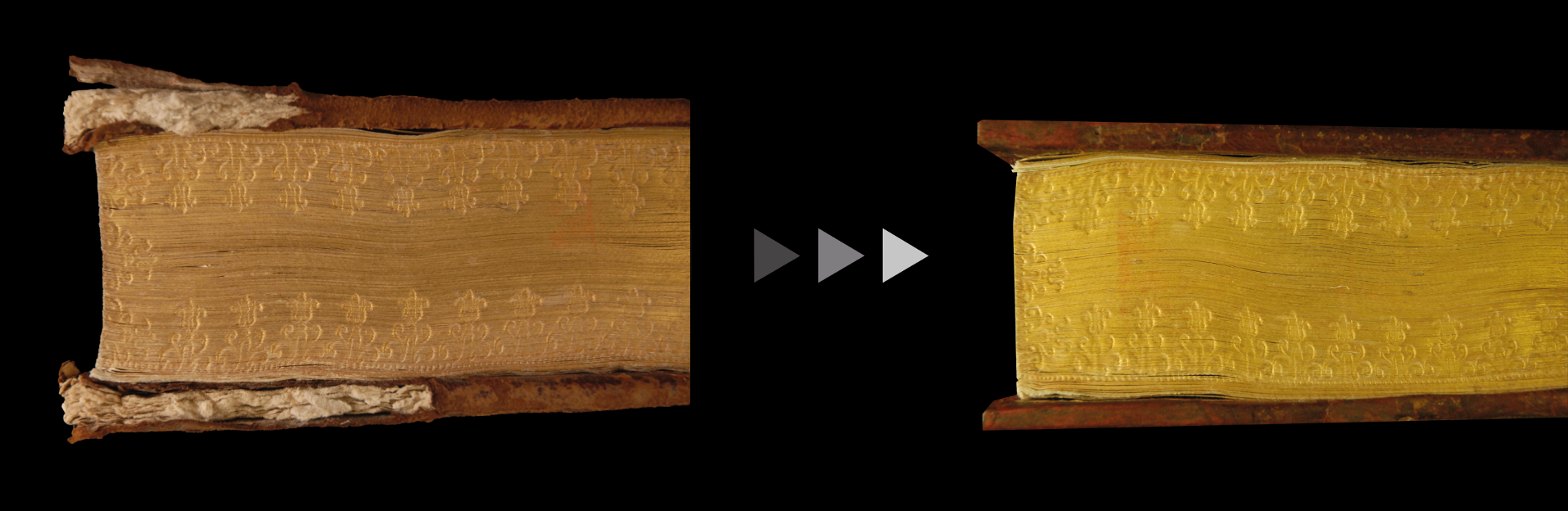
Consolidation techniques, which strengthen weak parts, allow us to return pages of century-old books to their original state (Composition 2) and, with restoration techniques, fully recover both the aesthetics and functionality of the books (Composition 3).
Composition 2
CONSOLIDATION (A 17TH CENTURY VOLUME)
SOURCE: Banco de España Library.
NOTE: Pleito por Pedro Pacheco, Marques de Castrofuerte, como tesorero de encasamentos de la Orden Militar de Alcántara con los herederos de Cristóbal y Marcos Fúcar hermanos, y Juan Cristóbal su Fator mayor en esta Corte.
Composition 3
RESTORATION (AN 18TH CENTURY VOLUME)
SOURCE: Banco de España Library.
NOTE: Colección de los tratados de paz, alianza, neutralidad, garantía ... hechos por los pueblos, reyes y príncipes de España, con los pueblos ... y demás potencias de Europa ... desde antes de la Monarquía Gótica hasta el feliz reinado de Felipe IV. Madrid. By Diego Peralta, Antonio Marín and Juan de Zúñiga, 1740. Parte I.
Did you know…?
Restoration of cultural works is guided by a set of ethical principles and technical criteria:
- Respect for physical and aesthetic integrity. A prior assessment is carried out as to whether any original elements need to be replaced and, if so, the restoration work must seek to reconstruct them faithfully.
- Use of stable materials. The products used must be stable over time, to prevent them from deteriorating quickly or causing long-term damage.
- Reversibility. Interventions should be reversible, allowing for future work to be carried out using new materials or techniques, without causing damage.
- Differentiation between new and original materials. The materials added must be clearly identifiable, to prevent any confusion with the original ones.
- Documentation of the process. What was done, and how and why it was done, needs to be understood to facilitate future interventions.
Who are we conserving this historical collection for?
The greatest reward for our efforts to keep this cultural legacy alive comes when we’re able to share it with the public. This has been the driving force behind each project connected to the Special Value Collection (SVC) since it was first created (Figure 2). And because of this, when the Institutional Repository was launched, we were able to include the Bibliographic Heritage collection, which features digitised copies of works from the SVC. This means that anyone interested can simply visit the repository, where digital copies of historic works from the Library are freely and openly available to consult or download, and discover an unexpected collection of treasures.
Figure 2
SPECIAL VALUE COLLECTION (SVC) TIMELINE
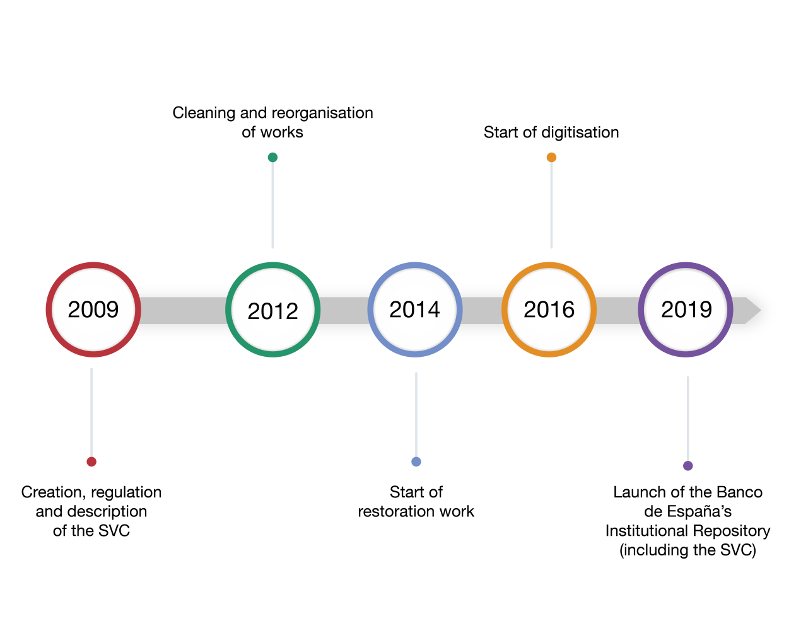
SOURCE: Devised by authors.
The Library remains dedicated to protecting its historical collection, to ensure it’s available to everyone
These works offer a glimpse of people and scenes from a different era. In fact, they have served as the basis for the public exhibitions hosted by the Banco de España Library in recent years, including those presenting the Count of Campomanes and Pathways and Landscapes. Spain in Travel Writing in the 17th to 19th century. Thanks to this heritage, the Bank and its Library will continue to open their doors for future exhibitions showcasing fresh aspects of our history.
The Library’s outreach efforts, however, go beyond its own collection, as it also takes part in collaborative initiatives such as Hispana and Europeana, which promote free and open digital access to the cultural heritage of Spain and Europe.
Preserving and showcasing our past form part of a project for the future. And in line with the initiative “An open bank” of the Banco de España’s Strategic Plan 2030, the Library remains dedicated to protecting its historical collection, to ensure it’s available to everyone.


DISCLAIMER: The views expressed in this blog post are those of the author(s) and do not necessarily coincide with those of the Banco de España or the Eurosystem.
