• Home
  • Economic Policy Uncertainty (EPU) Indices for South America and Mexico

Economic Policy Uncertainty (EPU) Indices for South America and Mexico

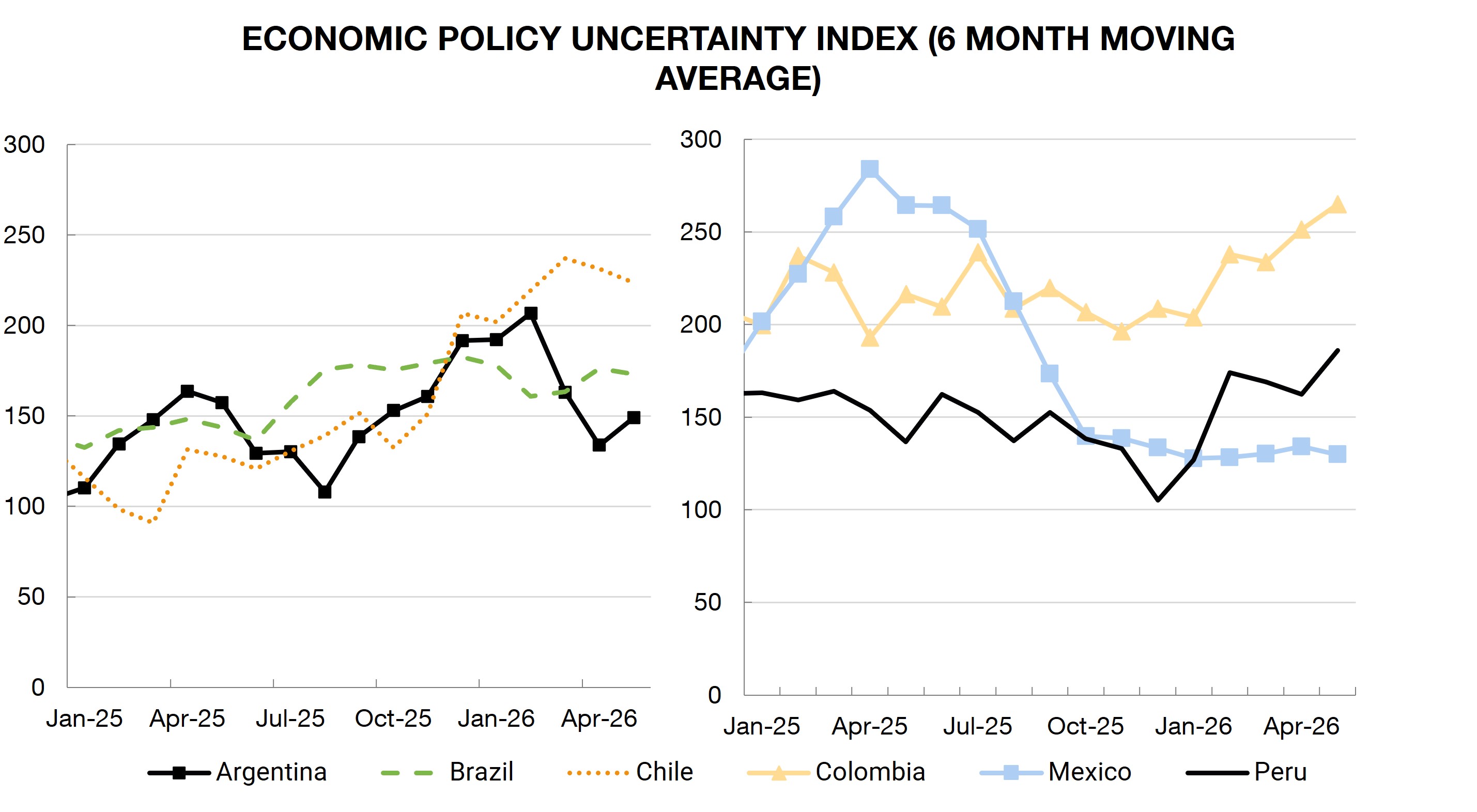
We develop indexes of economic policy uncertainty (EPU) for all Latin American countries.

First of all, we estimate the EPU for the six largest Latin American economies: Argentina, Brazil, Chile, Colombia, Mexico and Peru, as we have enough newspapers for all of them. More details about our methodology can be found in these two recent papers: Ghirelli, Pérez y Urtasun (2021)Opens in new window and Andres-Escayola, Ghirelli, Molina, Pérez y Vidal (2022). Similarly, we estimate EPUs for the remaining South American countries (Bolivia, Ecuador, Paraguay, Uruguay, and Venezuela). The working paper by Andres-Escayola, Molina, Pérez and Vidal (2025) File PDF: Opens in new window (4 MB) details the methodology used to develop these EPUs and shows that: i) regional EPU shocks reduce GDP growth, discourage capital inflows, and generate exchange rate instability; ii) Brazil and Mexico are primary sources of uncertainty contagion within the region; and iii) uncertainty shocks in Latin America impact both the financial and real variables of its main economic partners, with Spain being one of the most vulnerable countries.

For each of the countries we construct three types of EPU index, using the largest set of available newspapers with different levels of proximity to the country of interest

  • an index based on local newspapers (in Spanish or Portuguese for the case of Brazil);
  • an index based on foreign newspapers (both Anglophone and Spanish sources);
  • an index based on all of the aforementioned press, weighting equally each source irrespective of the level of proximity to the country of interest.

To construct the EPU index, we follow Baker, Bloom y Davis (2016)Opens in new window  and similar papers complied in their webpage Policy Uncertainty websiteOpens in new window. Below we post the keywords used for the Anglo-Saxon press:

  • Uncertainty: uncertain, uncertainty/uncertainties, unstable, instability/instabilities, risk(s).
  • Economy: economic(s), economy.
  • Policy: the name of the central bank of the country, the name of the government's workplace in the country, parliament, government, federal reserve, treasury, tariff(s), deficit(s), budget(s), public spending, debt ceiling, exchange rate(s), currency crash(es), sovereign debt, public debt, fiscal policy/policies, monetary policy/policies, legislation, reform(s), tax(es), overhaul, rule(s), norm(s), normative, regulation(s), law(s).

(for the words in Spanish and Portuguese please see Andres-Escayola, Ghirelli, Molina, Pérez y Vidal (2022) File PDF: Opens in new window (2 MB).)

We rely on Factiva's indexation to exclude all articles related to sports and leisure and to select articles about the country of interest.

The construction of the indexes is as follows. First, for each newspaper we count the number of articles published in a given month that contain words in the aforementioned blocks of keywords. Second, we express this count as a proportion of articles published by the newspaper in the month. When dealing with the local press, we divide this count by the total number of published articles that month, whereas in the foreign case we use the number of articles published that month that are about the country of interest. Third, we standardize each monthly series of scaled counts by dividing it by its standard deviation. Fourth, for each country we average the newspaper-based standardized series across newspapers to compute an aggregated index. Fifth, we rescale the resulting index to mean 100 to obtain a set of homogeneous country-based EPU indicators.

These indexes will be regularly updated in this webpage, and can be downloaded from this link File XLSX: Opens in new window (140 KB). Since the EPUs for Central America and the Dominican Republic are also estimated using the same methodology (link), researchers have a complete set of uncertainty indicators available for the entire Latin American region.

Local press

For each country, we consider the most-read local generalist newspapers available in Factiva:

  • Argentina: Clarín, La Nación, Infobae.
  • Bolivia: Opinión, La Razón, Los Tiempos.
  • Brasil: O Globo, Folha de Sao Paulo, O Estado de Sao Paulo, Correio Braziliense, Estado de Minas, Agencia Brasil.
  • Chile: El Mercurio, La Tercera, El Diario Financiero, Pulso.
  • Colombia: El Espectador, El Nuevo Siglo, Portafolio.
  • Ecuador: El Comercio, El Diario, Metro.
  • México: Reforma, El Universal, La Jornada, El Financiero, El Economista, Agencia Mexicana de noticias.
  • Paraguay: ABC Paraguay, Agencia Paraguaya de Noticias, Ultima Hora.
  • Perú: El Comercio, La Republica, Gestión, Agencia Peruana de noticias Andina
  • Uruguay: El País Uruguay, La República
  • Venezuela: El Universal, Tal Cual, Ultimas Noticias

For Bolivia, Paraguay and Uruguay, two news agencies are also included: Reuters Latin America and Corporación Financiera de Noticias..

For Brazil, we process articles written in Portuguese, while for all other countries we process articles in Spanish.

The EPU based on local press are available as from 2002m11 to present.

We select the following types of foreign press:

  • Anglo Saxon press: Los Angeles Times, The Boston Globe, The Globe and Mail, The New York Times, The Telegraph U.K., The Times U.K., Chicago Tribune, The Guardian U.K., The Wall Street Journal, The Washington Post, The Economist.
  • Spanish press: El País, El Mundo, Expansión, ABC, Cinco Días, El Economista, La Vanguardia.

All EPUs based on foreign press are available as from 1997m1 to the present.

The EPU index based on all press are constructed by pooling together all available sources (i.e. local and foreign newspapers), that is we pool together the local, Spanish and Anglophone press. All EPUs based on all press are available as from 1997m1 to the present.